SimBayLab is reader-supported. When you buy through links on this page, we may earn a commission at no extra cost to you. We don't test products hands-on: our picks are based on manufacturer specs, published tests and owner reports. How we research.
The right projector depends more on your room than on any spec sheet. Below, we cover six picks, then show the throw ratio math so you can check where each one would sit in your bay.
Quick Picks
- Best Overall: BenQ AH700ST
- Best Value: Optoma GT2400HDR
- Best Budget (closest to $1,000): Optoma GT2300HDR
- Best 4K: BenQ AK700ST
- Best 4K Value: BenQ TK710STi
- Best for Bright Rooms: Epson PowerLite L795SE
To compare current prices across sellers, see the SimBayLab golf simulator gear catalog (projectors, screens, mats and enclosures).
Golf Simulator Projector Comparison Table
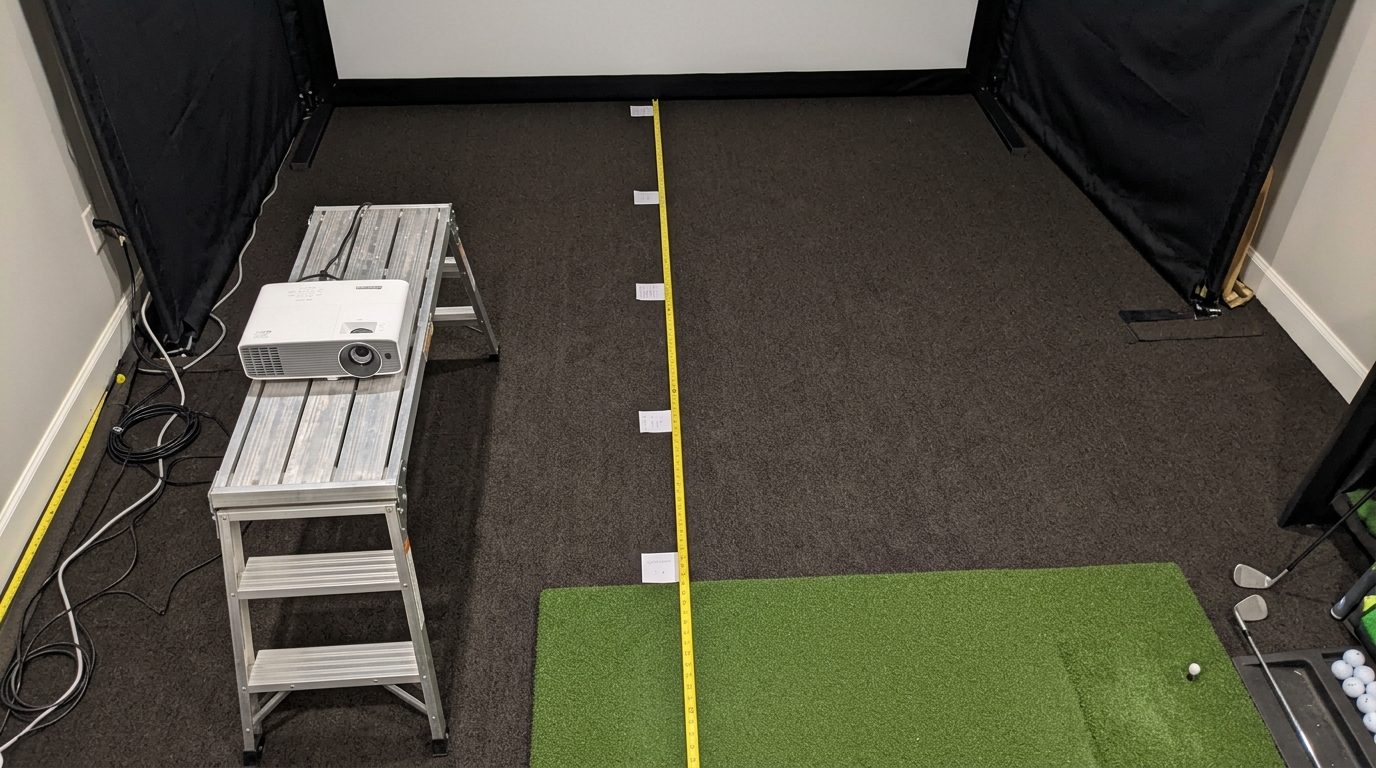
Prices are retailer prices at the time of writing, because BenQ and Optoma do not show prices on their US product pages. Some stores show a higher "compare-at" price next to these. That is the store's own reference price, not a confirmed manufacturer list price (MSRP), so we can't say whether a given price is a temporary Black Friday deal or the everyday price.
Projector: BenQ AH700ST · Store price: $2,299 · Throw ratio: 0.69-0.83 · Brightness: 4,000 ANSI lumens · Native resolution: 1080p · Lowest input lag: 16.7 ms
Projector: Optoma GT2400HDR · Store price: $1,299 · Throw ratio: 0.496 · Brightness: 4,200 lumens (ISO 21118) · Native resolution: 1080p · Lowest input lag: 8.4 ms
Projector: Optoma GT2300HDR · Store price: $1,099 · Throw ratio: 0.496 · Brightness: 3,600 lumens · Native resolution: 1080p · Lowest input lag: 8.4 ms
Projector: BenQ AK700ST · Store price: $2,899 · Throw ratio: 0.69-0.83 · Brightness: 4,000 ANSI lumens · Native resolution: 4K UHD · Lowest input lag: 8.4 ms
Projector: BenQ TK710STi · Store price: $2,199 · Throw ratio: 0.69-0.83 · Brightness: 3,200 ANSI lumens · Native resolution: 4K UHD · Lowest input lag: 4.2 ms
Projector: Epson PowerLite L795SE · Store price: $6,104 to $6,349 · Throw ratio: 0.79-1.36 · Brightness: 7,000 lumens (color/white) · Native resolution: 1920 x 1200 · Lowest input lag: 35.6 ms (ProjectorCentral test, 60Hz)
Input lag figures are the lowest the brand publishes, usually at 1080p and 120Hz or 240Hz. Your PC and sim software must send that refresh rate to get it. Epson publishes no figure, so its cell is a 60Hz measurement by ProjectorCentral, which is not directly comparable.
The Best Golf Simulator Projectors, Reviewed
1. BenQ AH700ST: Best Overall
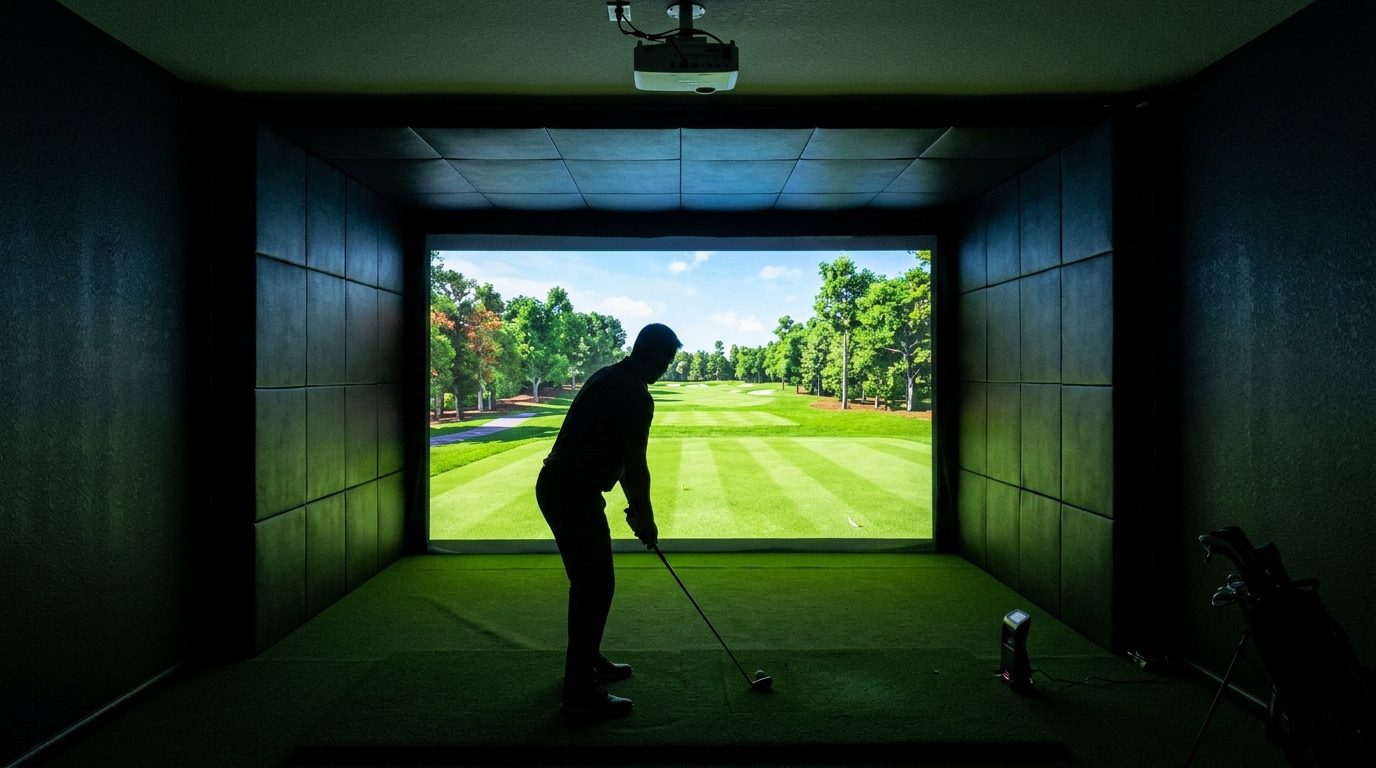
The BenQ AH700ST is a laser projector built for golf sims, with 4,000 ANSI lumens and native 1080p. Its 0.69-0.83 throw ratio comes from a motorized 1.2x optical zoom, so you can move the image size without moving the mount.
Auto Screen Fit is the feature that sets it apart. BenQ says it detects and adjusts to 16:9, 16:10, 4:3 and 1:1 screens, and works with gray impact screens, as long as the screen has at least 2.5 inches of black border.
BenQ lists input lag of 16.7 ms at 1080p 120Hz, up to 20,000 hours of light source life, and an operating range of 32-104°F. Price: $2,299 at Shop Indoor Golf and Rain or Shine Golf at the time of writing. Both stores also show a $2,499 compare-at price, which is their reference figure, not a confirmed BenQ list price.
Limits: it is 1080p, not 4K, and its lowest lag (16.7 ms) is higher than the Optoma models. At the long end of its throw range, it needs more room depth than a 0.5 throw projector.
Who it's for: most sim bays, especially if you are not sure yet of your final screen size. Who should skip it: very shallow rooms, and buyers who want 4K.
2. Optoma GT2400HDR: Best Value
The Optoma GT2400HDR has a 0.496:1 throw ratio, 4,200 lumens (ISO 21118) and a laser light source rated for 30,000 hours. Optoma lists a 30 to 300 inch image from about 13 to 130 inches away.
It ties the GT2300HDR for the lowest published lag among the native 1080p picks here: 8.4 ms at 1080p 120Hz. It accepts a 4K HDR signal and shows it at 1080p.
Price: $1,299 at Rain or Shine Golf and Shop Indoor Golf at the time of writing, with no sale shown. Optoma lists the GT2300HDR and GT2400HDR as IP6X dust-rated and rated for 0°C to 40°C (32-104°F).
Limits: the zoom is fixed, so the image size depends only on distance. That makes the mount position less flexible than with the BenQ zoom models.
Who it's for: shallow rooms and buyers who want a bright laser projector for around $1,300. Who should skip it: anyone who wants to fine-tune image size from a fixed mount.
3. Optoma GT2300HDR: Best Budget Pick
The Optoma GT2300HDR shares the 0.496:1 lens, 1080p resolution, 30,000 hour laser and 8.4 ms lag of the GT2400HDR. The difference is brightness: 3,600 lumens instead of 4,200.
Price: $1,099 at Rain or Shine Golf at the time of writing. None of the native 1080p laser short throw models at the stores we checked costs under $1,000, so this is the closest pick. Cheaper short throw models exist, but they are lower resolution (WXGA).
Limits: lower brightness means less margin for a gray screen or a room you can't fully darken. It also has a fixed zoom.
Who it's for: dark basements and budget builds. Who should skip it: garages with windows, where the extra $200 for the GT2400HDR buys more brightness.
4. BenQ AK700ST: Best 4K
The BenQ AK700ST brings native 4K UHD to the same 0.69-0.83 throw range and 4,000 ANSI lumens as the AH700ST. BenQ quotes 8.4 ms lag at 1080p 240Hz and 33.4 ms at 4K 60Hz.
BenQ says the IP5X dustproof sealed engine runs at 32-104°F, which suits garages. BenQ lists up to 20,000 hours of light source life. Price: $2,899 at Rain or Shine Golf and Shop Indoor Golf at the time of writing (Rain or Shine also shows a $2,999 compare-at price, its own reference figure, not a confirmed MSRP).
Limits: 4K needs a PC that can run your sim software at 4K, and the published 4K lag (33.4 ms) is higher than its 1080p modes. It costs $600 more than the AH700ST.
Who it's for: bays with a strong gaming PC and a large screen where you notice pixels. Who should skip it: anyone running a mid-range PC at 1080p.
5. BenQ TK710STi: Best 4K Value
The BenQ TK710STi is a 4K UHD laser projector with a 0.69-0.83 throw, 1.2x zoom and 3,200 ANSI lumens. BenQ lists 16.7 ms at 4K 60Hz and 4.2 ms at 1080p 240Hz, the lowest figures in this guide.
Price: $2,199 at Shop Indoor Golf and at Rain or Shine Golf at the time of writing (Rain or Shine also shows a $2,399 compare-at price, its own reference figure). That is $700 less than the AK700ST.
Limits: it is 800 lumens dimmer than the AK700ST on paper. It is sold as a gaming projector, and BenQ's 0-40°C operating spec gives no dust rating on the page we read.
Who it's for: dark rooms where you want 4K for less. Who should skip it: rooms with ambient light or gray screens.
6. Epson PowerLite L795SE: Best for Bright Rooms
The Epson PowerLite L795SE is a 3LCD laser projector rated at 7,000 lumens of color and white brightness. Its 0.79-1.36 throw range and 1.7x zoom give the most placement freedom here, and Epson lists images up to 400 inches.
Native resolution is WUXGA (1920 x 1200), with what Epson calls 4K Enhancement. Price: $6,349 on Epson's US store (shown out of stock) and $6,104 at Shop Indoor Golf at the time of writing. Shop Indoor Golf's compare-at price of $6,299.99 is lower than Epson's own price, a reminder that compare-at figures are not MSRP.
Limits: it costs more than double any other pick, and Epson does not publish an input lag figure. In a published test, ProjectorCentral measured 35.6 ms with a 60Hz HD signal, higher than the brand figures for the other picks at 120Hz. Its throw is longer, so it needs more room depth for the same image.
Who it's for: bays with windows, gray screens or large wide screens. Who should skip it: dark rooms, where a $1,300 projector does the job.
Also Considered
The BenQ AH500ST (0.5 throw, 4,000 ANSI lumens, 1080p) is $1,999 at Rain or Shine Golf at the time of writing (the store also shows a $2,099 compare-at price). It throws as short as the Optoma models but costs $700 more than the GT2400HDR, with higher published lag (16.7 ms).
The BenQ AW30ST ($1,199 at Shop Indoor Golf) is WXGA, not full 1080p, with 33.4 ms lag. The BenQ LK936ST ($4,899 at Rain or Shine Golf and Shop Indoor Golf) offers 5,100 ANSI lumens at 4K for buyers who want BenQ at the top end.
Throw Ratio Math: Where Will the Projector Sit?
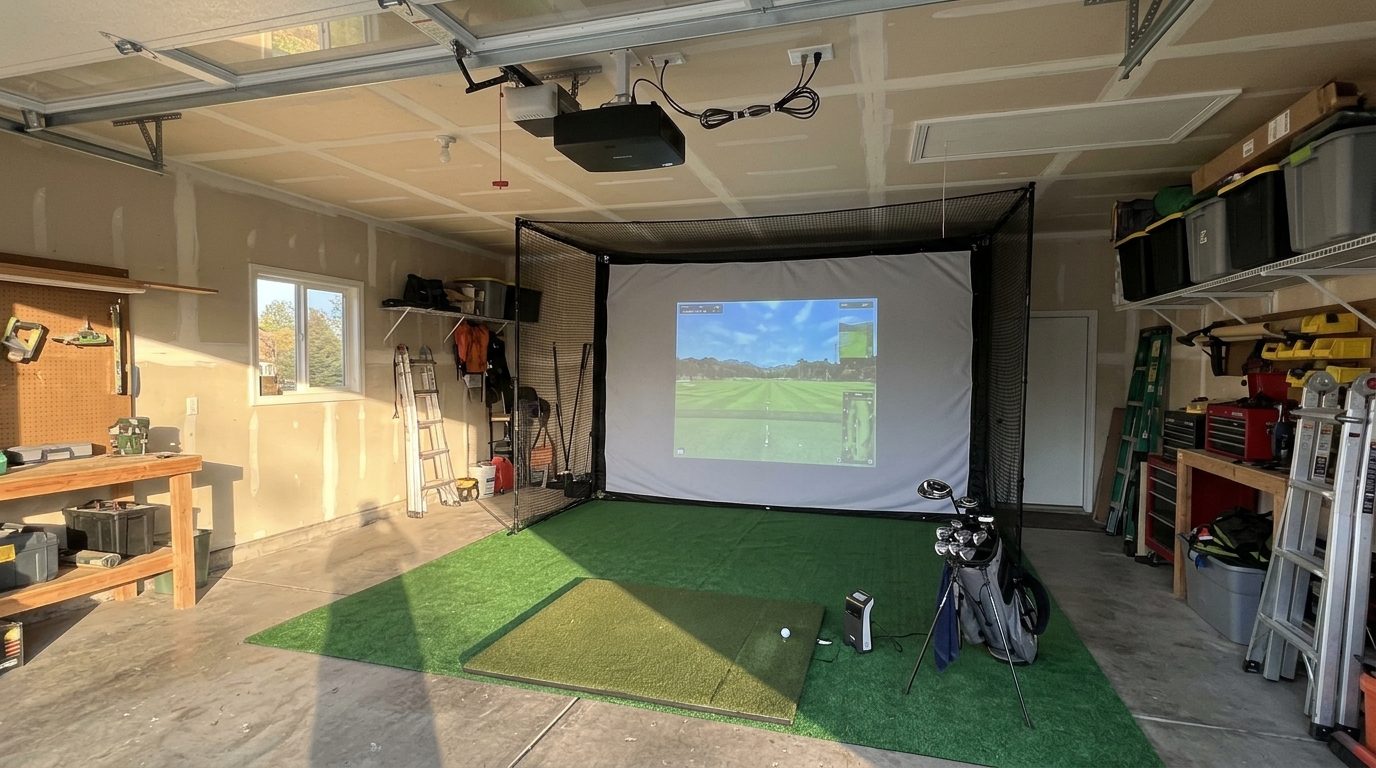
Throw ratio is distance divided by image width. So the distance from lens to screen equals the throw ratio times the width of the projected image.
Most golf projectors are native 16:9. On a 4:3 screen that is 8 ft tall, the 16:9 image must also be 8 ft tall to cover it, which makes the full image about 14.2 ft wide, with the sides spilling past the screen or masked in software (our calculation).
Throw ratio: 0.496 · Example models: Optoma GT2300HDR, GT2400HDR · 10.5 ft wide image: 5.2 ft · 8 ft tall image (14.2 ft wide): 7.1 ft · 9 x 16 ft screen (16:9): 7.9 ft
Throw ratio: 0.5 · Example models: BenQ AH500ST · 10.5 ft wide image: 5.3 ft · 8 ft tall image (14.2 ft wide): 7.1 ft · 9 x 16 ft screen (16:9): 8.0 ft
Throw ratio: 0.69-0.83 · Example models: BenQ AH700ST, AK700ST, TK710STi · 10.5 ft wide image: 7.2-8.7 ft · 8 ft tall image (14.2 ft wide): 9.8-11.8 ft · 9 x 16 ft screen (16:9): 11.0-13.3 ft
Throw ratio: 0.79-1.36 · Example models: Epson L795SE · 10.5 ft wide image: 8.3-14.3 ft · 8 ft tall image (14.2 ft wide): 11.2-19.3 ft · 9 x 16 ft screen (16:9): 12.6-21.8 ft
These are our estimates from published throw ratios. Always confirm with the brand's projection calculator, since lens offset and mount height also change the result.
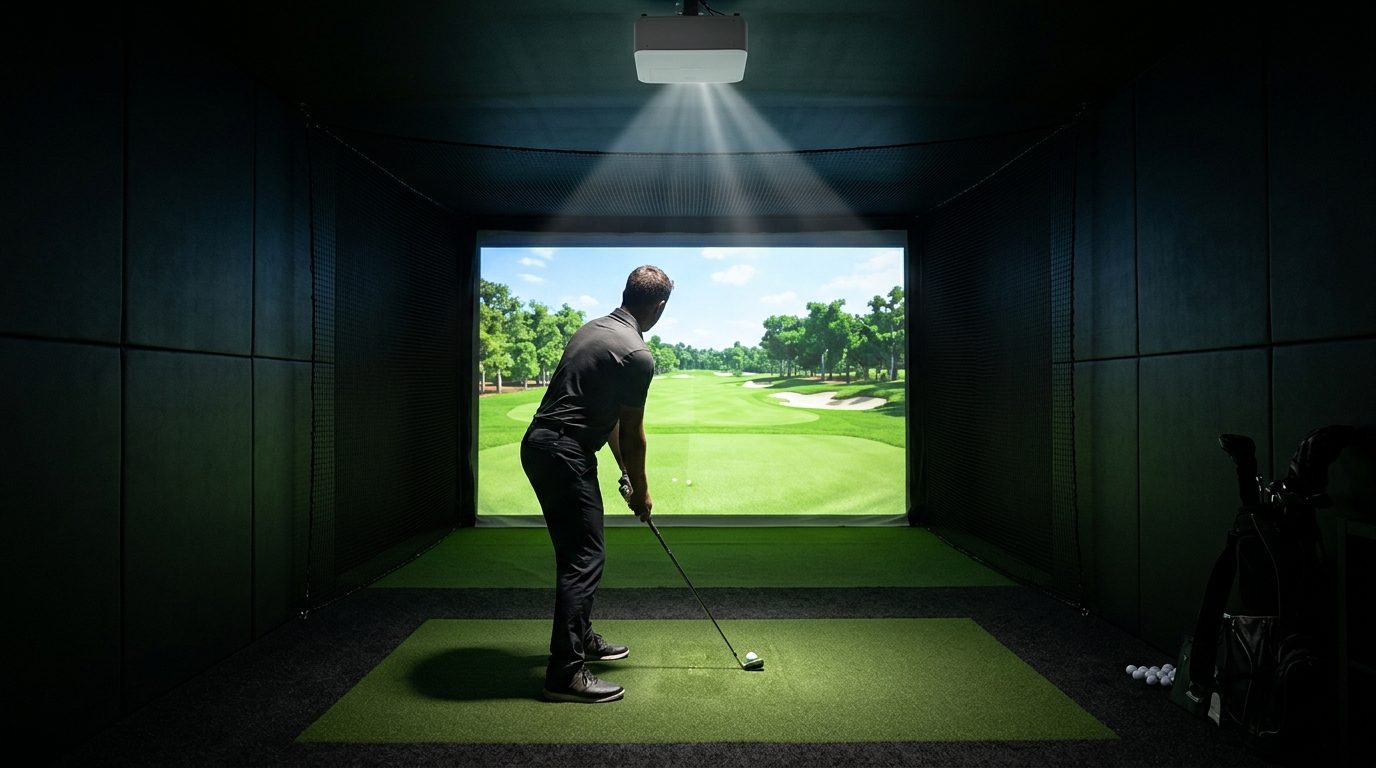
Now compare those numbers with where you stand. Brands like Uneekor and Shop Indoor Golf suggest about 10-12 ft from ball to screen, so a 0.5 throw projector ends up overhead, several feet in front of you.
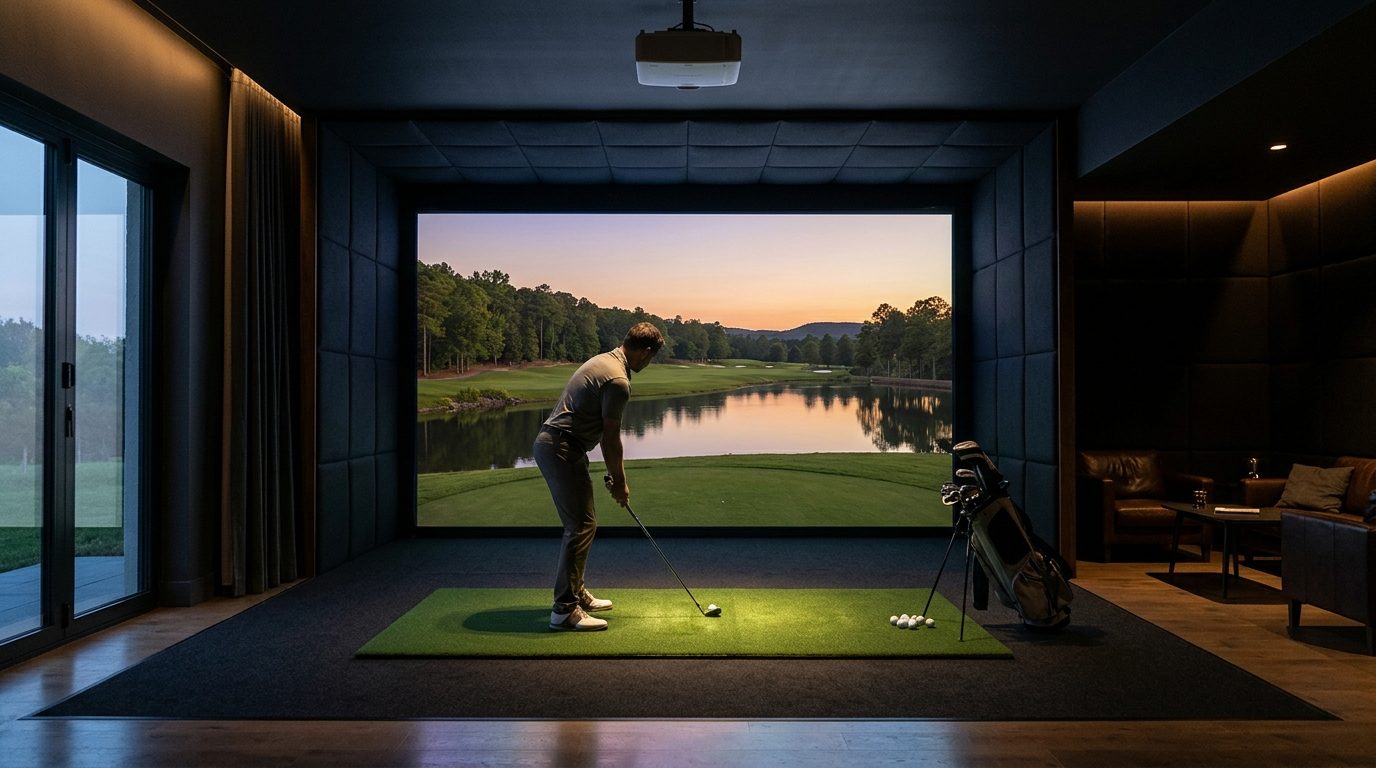
A 0.69-0.83 throw model sits farther back, close to your hitting position on a large image, and BenQ says its short throw golf models can go behind the golfer, away from pop-up shots. Our guide to golf simulator room dimensions helps you map this on your floor plan.
How to Choose a Projector for Your Golf Simulator
Short Throw vs Ultra Short Throw vs Standard
Short throw is the standard for golf sims because it makes a big image from a short distance and mounts out of your swing. Standard throw projectors need much more distance, so they often end up behind the golfer, where your body can cast a shadow on the screen.
Ultra short throw projectors sit just inches from the screen. In a sim bay, that puts them on the floor in front of the screen, right in the path of your shots.
Lumens and Room Light
More lumens help when you can't make the room dark, or when you use a gray screen. BenQ quotes ANSI lumens while Optoma and Epson quote ISO 21118 lumens, so don't read too much into small gaps between brands.
Your screen plays a big part in picture quality too. Our guide to the best golf impact screen explains white vs gray screens and weave.
4:3 vs 16:9 Screen Fit
Rain or Shine Golf says 4:3 is the most popular screen ratio, because most rooms have the height for golf but not the width for widescreen. With a 16:9 projector on a 4:3 screen, you either accept black bars or let the image spill past the screen and mask it.
BenQ's Auto Screen Fit on the AH700ST handles 4:3 and 1:1 screens. With the other models, you set the output in your PC and sim software.
Input Lag
Input lag is the delay between your PC sending a frame and the projector showing it. Lower is better, and most brands publish their lowest numbers at 1080p with 120Hz or 240Hz input.
Resolution: 1080p or 4K
A 4K projector needs a PC that can run your sim software at 4K. If your graphics card targets 1080p, a 1080p projector like the AH700ST or GT2400HDR makes more sense.
Mounting, Heat and Power
Mount the projector high and out of the swing path, inside the frame of your enclosure if it has one. Our guide to the best golf simulator enclosure covers kits. Check whether yours includes a projector mount: Shop Indoor Golf's SIG V2, for example, does not.
Projectors make heat, so leave space around the vents and check the operating range: BenQ and Optoma list about 32-104°F for the models here. If you need a new ceiling outlet or circuit, hire a licensed electrician rather than running power yourself.
A projector is often the second biggest line in a sim budget after the launch monitor. Our golf simulator cost breakdown shows how it fits into the total.
FAQ
What throw ratio do I need for a golf simulator?
Most golf sim projectors use a short throw ratio between about 0.5 and 0.83. Multiply the throw ratio by the image width to get the distance from lens to screen. A 0.5 throw makes a 10.5 ft wide image from about 5.3 ft, while 0.69-0.83 needs 7.2 to 8.7 ft.
How many lumens does a golf simulator projector need?
There is no single number, because it depends on room light and screen color. The picks here range from 3,200 to 7,000 lumens. In a dark room, 3,200 to 4,000 lumens is common, while a garage with windows or a gray screen benefits from a brighter model.
Is 4K worth it for a golf simulator?
Only if your PC can run your sim software at 4K. A 4K projector like the BenQ AK700ST or TK710STi shows more detail on large screens, but at 1080p the AH700ST or GT2400HDR costs less. Check your graphics card before you pay for 4K.
Can I use a regular home theater projector?
You can, but most home theater models are standard throw. They need to sit far back, often behind you, where your body can cast a shadow and the room may not be deep enough. Short throw projectors are made to avoid that problem.
Where should a golf simulator projector be mounted?
Usually on the ceiling, high and out of your swing path, at the distance your throw ratio requires. BenQ says its short throw golf models can sit behind the golfer, away from pop-up shots. Hire a licensed electrician for any new ceiling outlet.