SimBayLab is reader-supported. When you buy through links on this page, we may earn a commission at no extra cost to you. We don't test products hands-on: our picks are based on manufacturer specs, published tests and owner reports. How we research.
This guide covers the floor plan: depth, width, where to stand and how far the screen should be. Ceiling height gets its own guide, and so do garage quirks.
Quick Answer
- Depth: radar behind the ball needs unit distance plus ball flight, about 14 to 20 ft by the published figures (our sums). Camera units need roughly 10 to 12 ft from ball to screen plus swing room behind you.
- Width: Uneekor asks for at least 13 ft for a full driver swing, 15 ft if you are 6 ft or taller. Shop Indoor Golf says plan on 14 ft to center the tee for both righties and lefties.
- Height: most published guidance starts at 9 ft, with 10 ft for overhead units and taller golfers.
- Screen distance: Carl's Place says stand 10 to 12 ft from the screen, and hang the screen 12 to 16 in off the wall.
- Rule: check your launch monitor's manual, then the enclosure's minimum room.
How Golf Simulator Room Dimensions Add Up
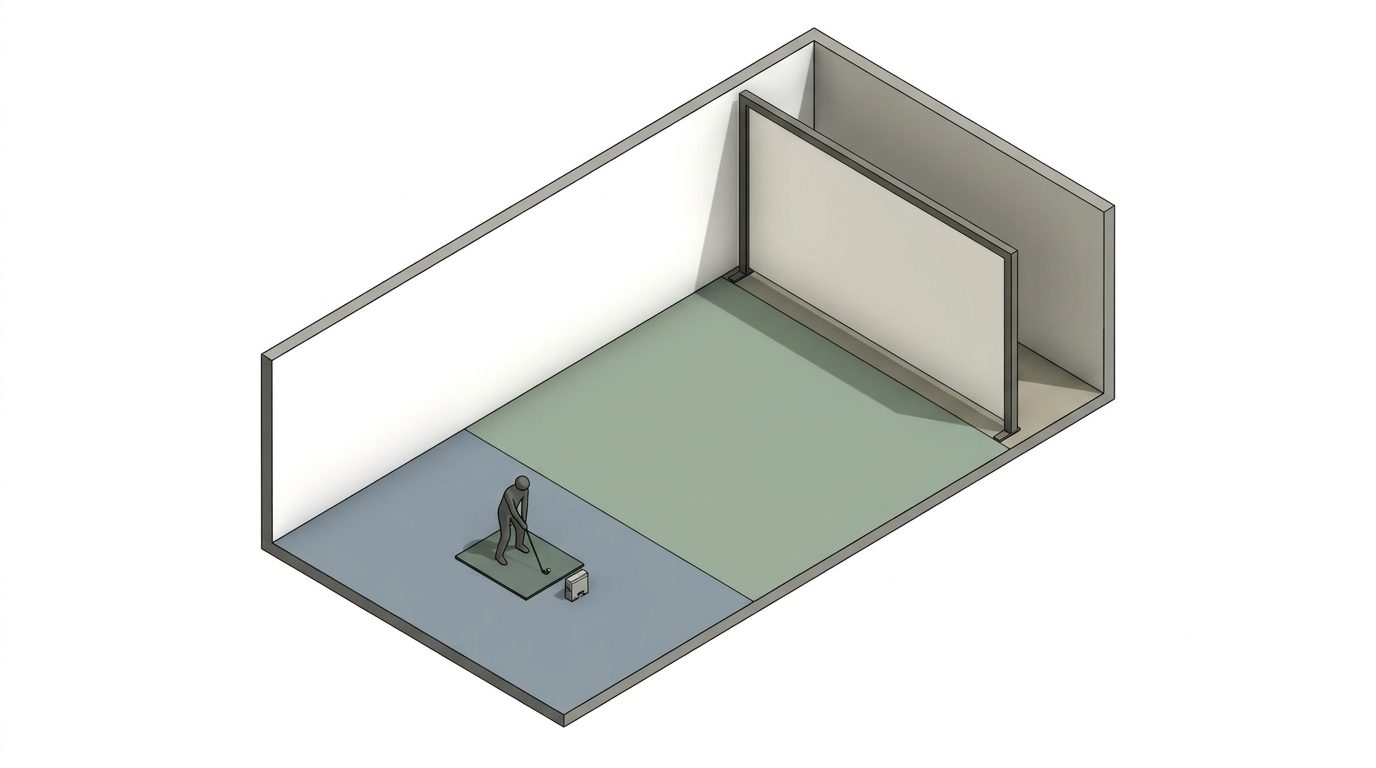
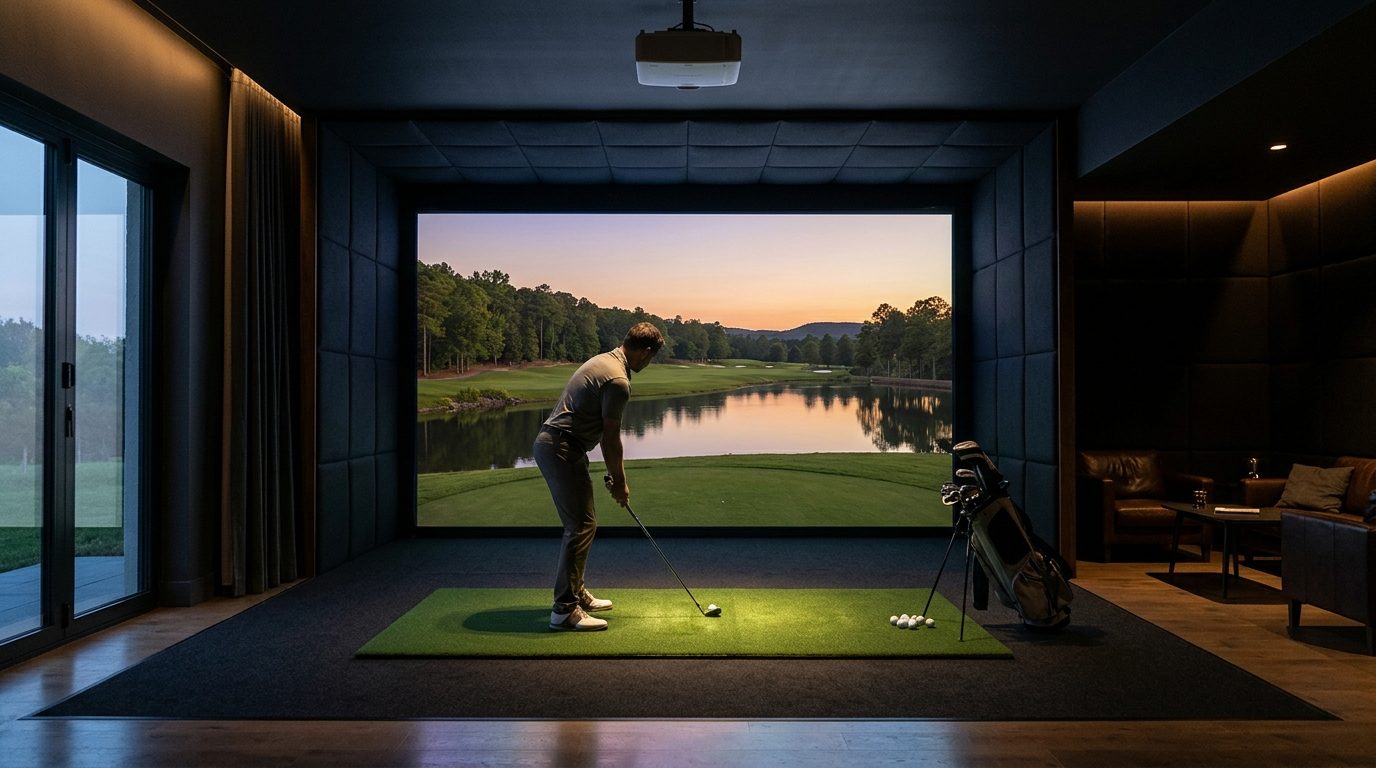
Think of the room as three zones in a line: swing space behind the ball (plus the unit, if it is a radar behind you), ball flight to the screen, then a gap between the screen and the wall.
Width is about your swing arc and safety on both sides. Height is about your swing and anything mounted overhead, which our ceiling height for golf simulator guide covers in detail.
Shop Indoor Golf breaks an 18 ft depth down this way: screen 9 to 12 in from the rear wall, tee 10 to 12 ft from the screen, and 7 ft behind the tee for an unobstructed swing. Its stated minimum is 13 ft deep with the ball 10 ft from the screen, and 15 ft gives its recommended 12 ft.
Manufacturer Space Requirements by Launch Monitor
The table lists only figures the maker publishes. "Not published" means no number appears on the manufacturer pages and manuals we read. Where we added two published distances together, the cell says "our sum".
Launch monitor: Garmin Approach R10 · Type and placement: Radar, behind ball · Unit to ball: 6-8 ft · Ball to screen: 8 ft min · Room depth: About 14 ft (our sum) · Room width: Not published · Ceiling: Not published
Launch monitor: Rapsodo MLM2PRO · Type and placement: Hybrid, behind ball · Unit to ball: 6.5-8.5 ft · Ball to screen: 8 ft · Room depth: "A little more than 14" ft · Room width: Not published · Ceiling: Not published
Launch monitor: Rapsodo MLM2XPRO · Type and placement: Hybrid, behind ball · Unit to ball: 7.5 ft · Ball to screen: 8 ft min · Room depth: "A little more than 15" ft · Room width: Not published · Ceiling: Not published
Launch monitor: FlightScope Mevo Gen2 · Type and placement: Hybrid, behind ball · Unit to ball: 8 ft · Ball to screen: 8 ft · Room depth: About 16 ft (our sum) · Room width: Not published · Ceiling: Not published
Launch monitor: Full Swing KIT · Type and placement: Radar + camera, behind ball · Unit to ball: 8-10 ft · Ball to screen: 8-10 ft · Room depth: 16-20 ft (our sum) · Room width: Not published · Ceiling: Not published
Launch monitor: TrackMan 4 · Type and placement: Radar, behind ball · Unit to ball: Not published · Ball to screen: Not published · Room depth: 18 ft+ screen to unit · Room width: 15 ft+ · Ceiling: 10 ft+
Launch monitor: Garmin Approach R50 · Type and placement: Camera, side of ball · Unit to ball: About 1.5 ft to the side · Ball to screen: Not published · Room depth: Not published · Room width: Not published · Ceiling: "Adequate"
Launch monitor: SkyTrak ST MAX · Type and placement: Hybrid, side of ball · Unit to ball: Beside the ball · Ball to screen: Not published · Room depth: 10 ft min area · Room width: 10 ft min area · Ceiling: Depends on you and club
Launch monitor: Bushnell Launch Pro · Type and placement: Camera, side of ball · Unit to ball: About 2 ft · Ball to screen: Not published · Room depth: Not published · Room width: Not published · Ceiling: Not published
Launch monitor: Foresight GC3 · Type and placement: Camera, side of ball · Unit to ball: Not published · Ball to screen: Not published · Room depth: Not published · Room width: Not published · Ceiling: Not published
Launch monitor: Uneekor EYE XO2 / EYE XR · Type and placement: Camera, ceiling · Unit to ball: Overhead · Ball to screen: Not published · Room depth: 16 ft min · Room width: 13 ft min · Ceiling: 10 ft min
Launch monitor: TrackMan iO · Type and placement: Radar + cameras, ceiling · Unit to ball: Overhead · Ball to screen: 10 ft+ · Room depth: Not published · Room width: 15 ft+ · Ceiling: 10 ft+
Sources, all read in November 2026: the Garmin Approach R10 and Garmin Approach R50 owner's manuals, the Rapsodo MLM2PRO and Rapsodo MLM2XPRO product FAQs, the FlightScope Mevo Gen2 page, the Full Swing KIT page, the SkyTrak ST MAX user guide, the Bushnell Launch Pro manual, the Foresight GC3 page and the Uneekor EYE XO2 and Uneekor EYE XR pages.
The TrackMan figures come from Trackman's own blog post How Much Room for a Golf Simulator. The TrackMan iO page adds that there are "no minimum distance requirements in front of or behind the ball", and that the iO DUO fits bays "as narrow as 10 feet in width".
Two caveats. Full Swing's US KIT FAQ says indoors you need "8-10 feet of ball flight to the screen or net and 8-10 feet of space behind the golf ball", while its KIT Studio package minimum (9 ft ceiling, 12 ft width, 18 ft length) was only readable on its European site. Square Golf publishes its space specs as an image we could not read: [TO VERIFY].
Depth: Radar Behind You vs Camera Beside or Above You
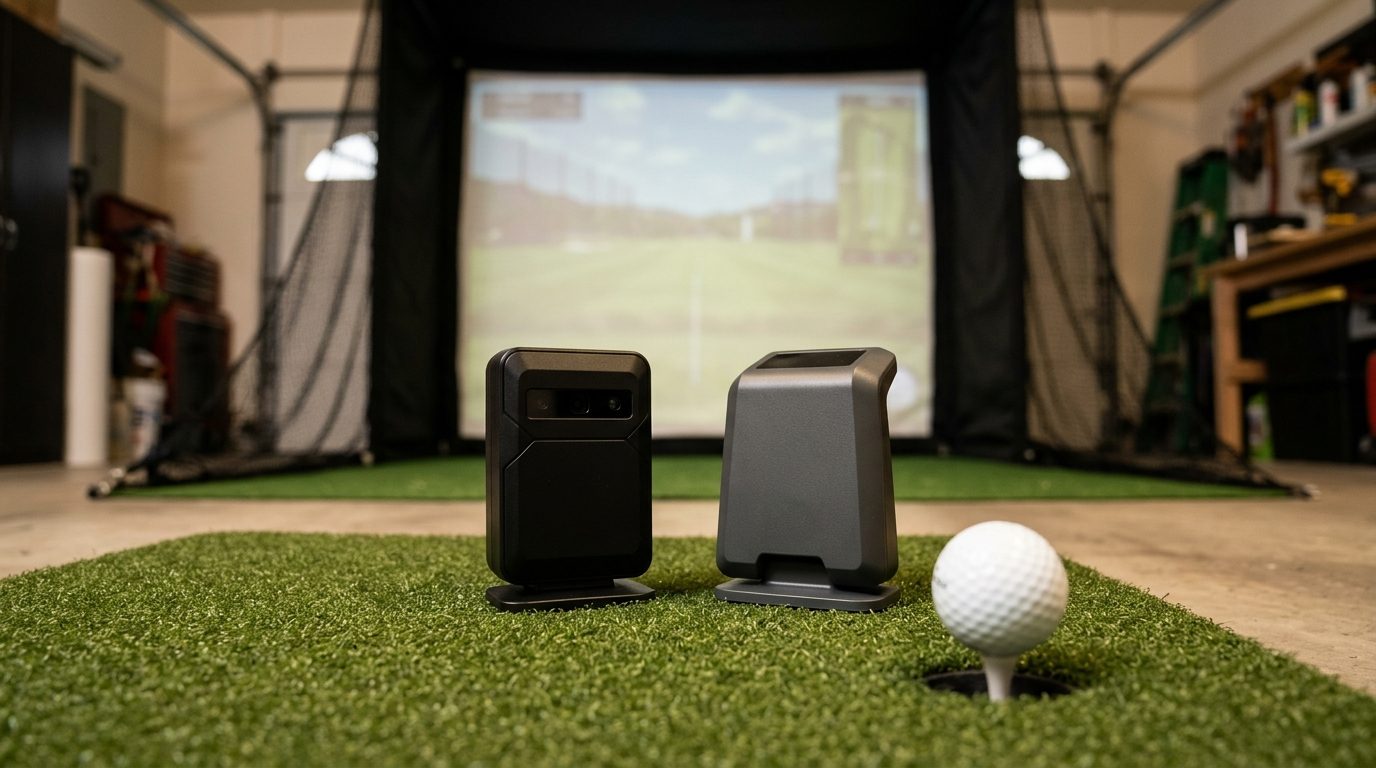
Radar and Hybrid Units Behind the Ball
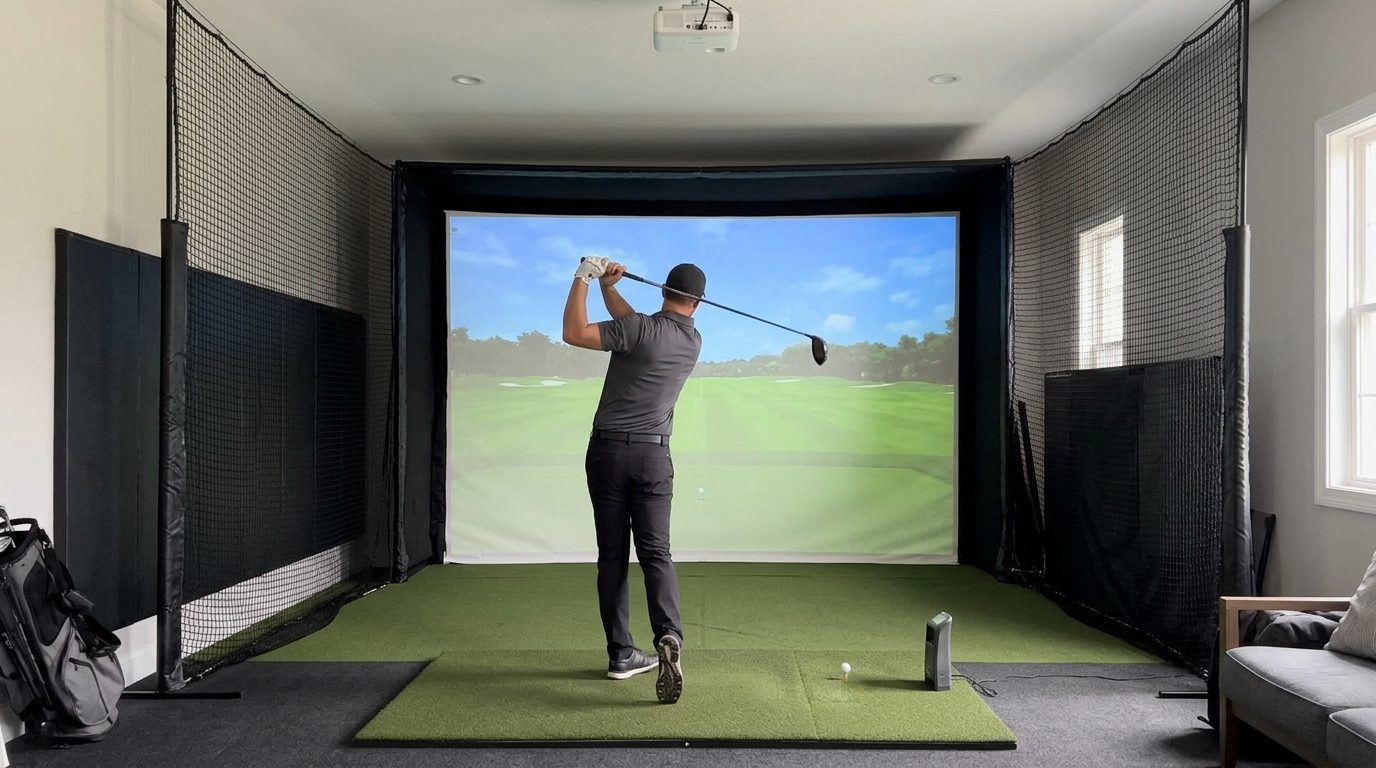
A unit that sits behind you needs its own distance plus room for the ball to fly before it hits the screen. Rapsodo puts it simply for the MLM2PRO: "A little more than 14 total feet is needed," and "Taller players may need to place the device further back."
Those figures stop at the screen, so add the gap behind it (see below). If your room is short on depth, a side-of-ball or overhead unit is the usual workaround, and our best golf launch monitor guide compares them across price levels.
Side-of-Ball and Overhead Camera Units
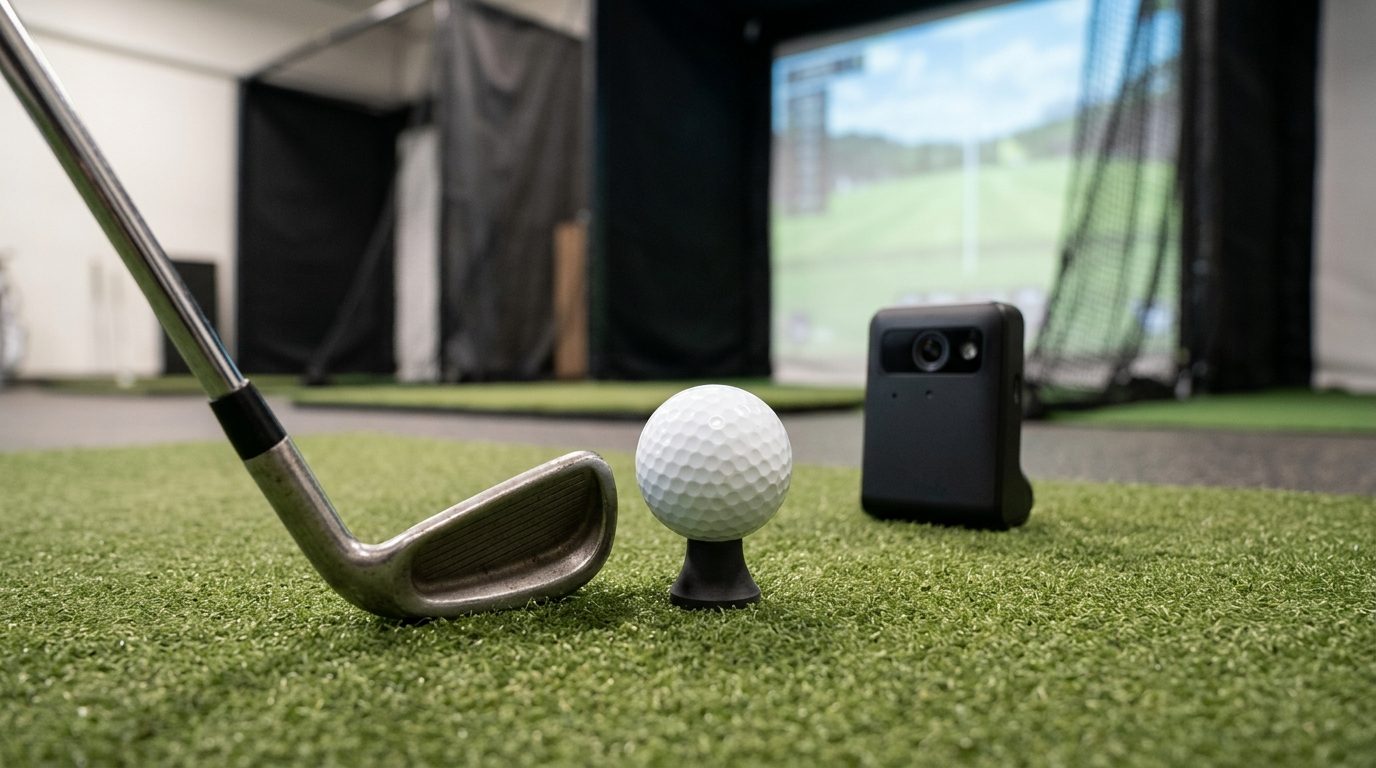
Camera units that sit beside the ball (Garmin R50, Bushnell Launch Pro, Foresight GC3, SkyTrak ST MAX) or on the ceiling (Uneekor EYE XO2 and EYE XR, TrackMan iO) don't need space behind you for the unit. Their depth is set by ball-to-screen safety distance and your swing.
Here the published guidance converges on 10 to 12 ft from ball to screen. Uneekor recommends at least 12 ft "for safety purposes" and says 10 ft "may suffice" if you watch for bounce-back. Shop Indoor Golf uses the same 10 ft minimum and 12 ft recommendation.
The Gap Behind the Screen
An impact screen needs air behind it so the ball does not slam into the wall. Carl's Place says hang it "at least 12-16" away from the wall"; Shop Indoor Golf says 9 to 12 in. The Net Return asks you to "allow 6 inches behind the bay", and the HomeCourse retractable screen mounts 18 in from the wall.
Width: Righty, Lefty and Shared Bays
Uneekor says the wall-to-wall distance "should be at least 13 ft to allow for full driver swings (at least 15 ft for golfers 6 ft or taller)." Trackman calls 15 ft "a strong benchmark" for a single golfer.
If a right-handed and a left-handed golfer share the bay, the tee usually goes in the middle. Shop Indoor Golf says to plan on 14 ft if you want the tee centered for both right- and left-handed players. In a narrower room, it says you can adjust the tee's placement to fit a more compact space.
How the Launch Monitor Changes the Offset
Radar and hybrid units behind the ball are the most flexible, since they sit on the target line. For the MLM2XPRO, Rapsodo tells lefties to "Place the device the same way, 7.5 feet behind the ball" and switch the handedness setting.
Side-of-ball units sit across the ball from you and must face it: Garmin says the R50 goes about 1.5 ft to the side of the tee, Bushnell about 2 ft from the hitting area. Bushnell, SkyTrak and Garmin all list a left or right-handed setting in their manuals. Because the unit sits across the ball from the golfer, a lefty usually means moving it to the other side, so check your manual.
Overhead units fix the hitting zone under the camera. The EYE XO2 lists a 28 x 21 in hitting zone, the EYE XR 14 x 12 in, so the tee spot is set when you mount it.
Enclosure Footprints and Minimum Rooms
Enclosure makers also publish a minimum room, and it is often bigger than the frame itself. Use the larger of the two numbers: the launch monitor's or the enclosure's.
Enclosure: SIG8 V2 · Frame (W x H x D): 8'4" x 8'4" x 5'0" · Min room width: 10 ft · Min room depth: 16 ft · Min ceiling: 9 ft
Enclosure: SIG10 V2 · Frame (W x H x D): 10'10" x 8'4" x 5'0" · Min room width: 12 ft · Min room depth: 18 ft · Min ceiling: 9 ft
Enclosure: SIG12 V2 · Frame (W x H x D): 12'2" x 9'4" x 5'0" · Min room width: 14 ft · Min room depth: 20 ft · Min ceiling: 10 ft
Enclosure: Net Return Bay 8 / 10 / 12 · Frame (W x H x D): 8, 10 or 12 ft x 8'6" x 3'6" · Min room width: 10 / 12 / 14 ft · Min room depth: 14 ft · Min ceiling: 9 ft
Enclosure: SwingBay 8 x 10.5 · Frame (W x H x D): 10'5" x 8' x 4'2" · Min room width: 11 ft footprint · Min room depth: 15 ft footprint · Min ceiling: 8.1 ft footprint
Enclosure: HomeCourse ProScreen 180 · Frame (W x H x D): About 10' wide, 8'6" high · Min room width: 10'6" with arms · Min room depth: 10-12 ft front to back · Min ceiling: Not published
Sources: the Shop Indoor Golf SIG V2 page, The Net Return Simulator Bay page, the Rain or Shine SwingBay page and the HomeCourse ProScreen 180 listing at Shop Indoor Golf. Net Return adds that some launch monitors need up to 22 ft of room length.
Your projector also takes floor or ceiling space. BenQ says its short throw golf models let you place the projector "behind the golfer", out of the swing path, and our best projector for golf simulator guide covers throw ratio math for your room.
Where to Put the Hitting Position
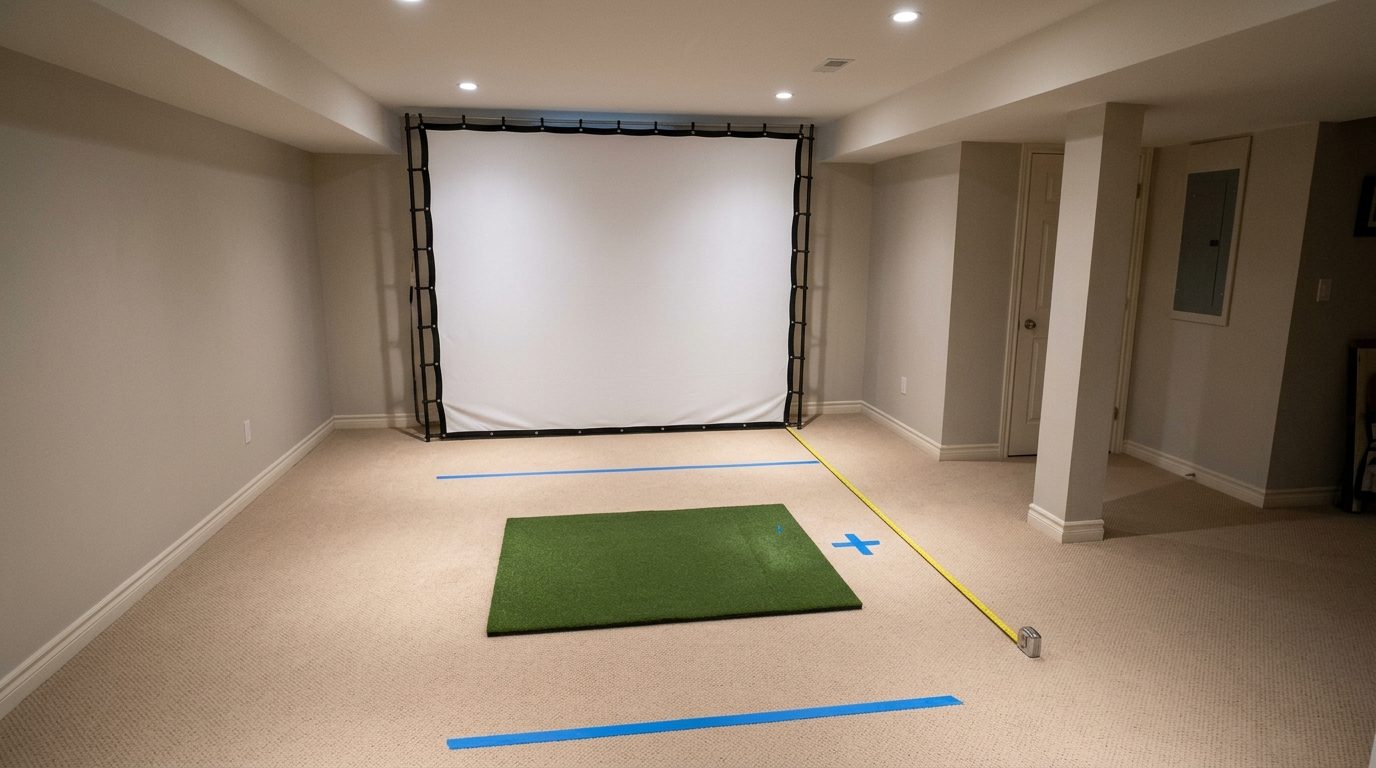
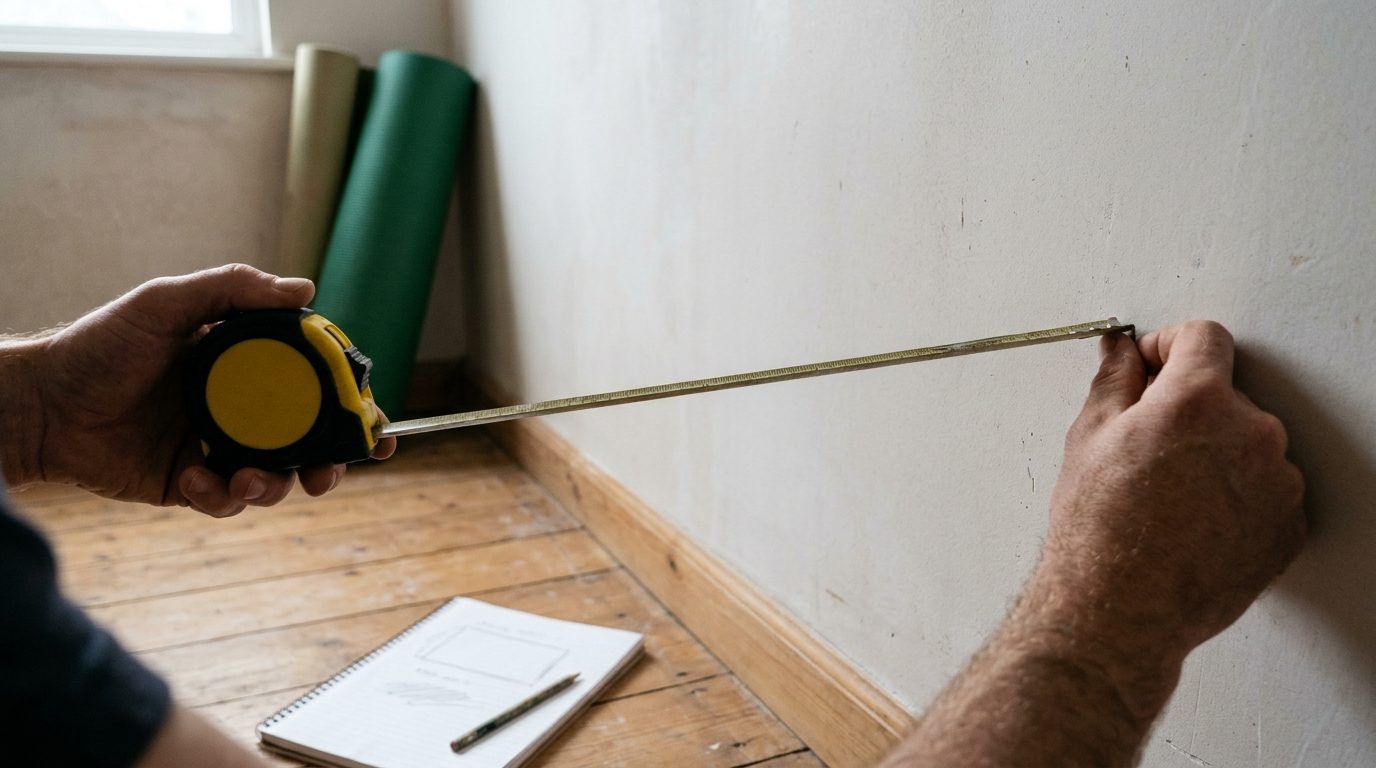
Start from the screen and work back. Mark the screen line, then the ball spot 10 to 12 ft away, then the launch monitor spot from your manual. Tape these on the floor before you buy anything.
- Behind the ball: leave at least 7 ft of clear space for the backswing, the figure Shop Indoor Golf uses in its depth breakdown.
- Side to side: center the tee for a shared bay, or follow your enclosure maker's tee guidance in a narrow room.
- Obstacles: note doors, windows, beams, ducts, lights and, in a garage, the opener rail. Our garage golf simulator guide covers door tracks and parking.
Then, with no ball and nobody near you, make a slow practice swing with your driver at the taped tee spot. If the club comes near a wall, move the tee before you order a screen.
How to Measure Your Room
- Measure wall to wall at floor level and at shoulder height, since shelves and trim eat inches.
- Measure depth from the wall where the screen will hang to the opposite wall, along the target line.
- Measure the ceiling at the tee spot and at the screen, not just the room's center.
- Write down the smallest number in each direction. That is your real room.
FAQ
What is the minimum room size for a golf simulator?
It depends on the launch monitor. SkyTrak lists a 10 x 10 ft minimum area for the ST MAX, and Uneekor lists 13 x 16 x 10 ft for its EYE XO2 and EYE XR. Radar units behind the ball need about 14 to 20 ft of depth by their makers' figures, so always check your own manual.
How deep should a golf simulator room be?
Shop Indoor Golf calls 18 ft ideal and 13 ft its minimum for side and overhead units. Radar units behind the ball need the unit distance plus about 8 ft of ball flight: Rapsodo says a little more than 14 ft for the MLM2PRO, and FlightScope's figures for the Mevo Gen2 add up to about 16 ft.
How wide does a golf simulator room need to be?
Uneekor says at least 13 ft for a full driver swing, or 15 ft if you are 6 ft or taller. Trackman calls 15 ft a strong benchmark for one golfer. Shop Indoor Golf says plan on 14 ft if you want a centered tee for both righties and lefties.
How far should I stand from a golf simulator screen?
Carl's Place says stand at least 10 to 12 ft from the screen, warning that closer positions bring more bounce-back. Uneekor recommends 12 ft for safety and says 10 ft may suffice. Leave 6 to 16 in behind the screen, depending on the screen or enclosure maker.
Can a lefty and a righty share one simulator?
Yes, if the room is wide enough for a centered tee, which Shop Indoor Golf puts at 14 ft. Radar units behind the ball handle it most easily. Side-of-ball units usually need to be moved across the tee and switched to the other hand in the software.
Models mentioned in this article
Also compare: Hybrid (radar and camera) launch monitors · Launch monitors under $1,000