SimBayLab is reader-supported. When you buy through links on this page, we may earn a commission at no extra cost to you. We don't test products hands-on: our picks are based on manufacturer specs, published tests and owner reports. How we research.
A sim mat is the part of your setup you touch on every swing. Below, we compare six mats on real-tee support, joint-friendly build, height, size, warranty and price, using manufacturer specs.
Quick Picks
- Best Overall: SIGPRO Softy 4' x 7'
- Best Value: SwingTurf Golf Hitting Mat
- Best Under $400: Spornia ProStrike 5' x 5'
- Best Fairway Feel: TrueStrike Single (gel strike section)
- Best Premium Studio Mat: Fiberbuilt Player Preferred Studio 8' x 4'
- Best Long Mat for Wide Bays: SIGPRO Softy Tour 4' x 10'
To compare current prices across sellers, see the SimBayLab golf simulator gear catalog (hitting mats, screens, projectors and enclosures).
Golf Simulator Mat Comparison Table
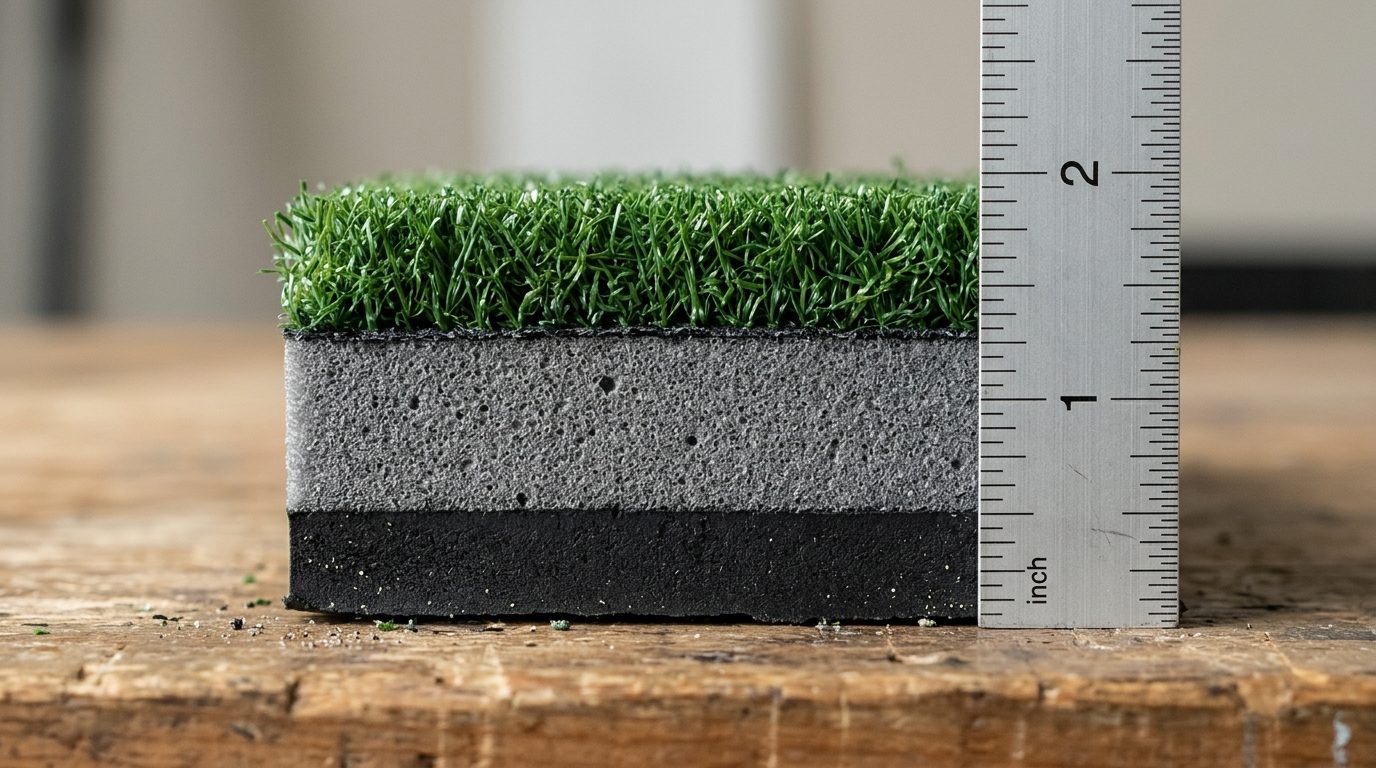
Prices are at the time of writing, regular price first and Black Friday sale price second when a store shows one. Height is the overall mat height the brand lists.
Mat: SIGPRO Softy · Size: 4' x 7' · Price (regular / sale): $999.99 / $749.99 · Height: 2.5 in · Real tee: Yes · Warranty: 1 year
Mat: SwingTurf · Size: 4' x 4' to 4' x 9' · Price (regular / sale): From $449 / $399 · Height: 1.7 in · Real tee: Yes, anywhere · Warranty: 3 years
Mat: Spornia ProStrike · Size: 5' x 5' · Price (regular / sale): $399.99 / $359.99 · Height: 1.5 in · Real tee: Yes · Warranty: [TO VERIFY]
Mat: TrueStrike Single · Size: 77 x 52 in · Price (regular / sale): $1,098 (no sale shown) · Height: 2 3/8 in · Real tee: Yes (tee holder) · Warranty: 12 months
Mat: Fiberbuilt Studio · Size: 8' x 4' · Price (regular / sale): $1,499 (no sale shown) · Height: 1.75 in · Real tee: Yes (tee holder) · Warranty: [TO VERIFY]
Mat: SIGPRO Softy Tour · Size: 4' x 10' · Price (regular / sale): $1,399.99 / $1,049.99 · Height: 2.5 in · Real tee: Yes · Warranty: 1 year
The Best Golf Simulator Mats, Reviewed
1. SIGPRO Softy 4' x 7': Best Overall
The SIGPRO Softy from Shop Indoor Golf is a 4' x 7' mat, 2.5 inches tall and 21 lbs. It uses 1-inch Teeline turf over a soft foam insert, with a 28" x 12" hitting strip you can replace when it wears.
It ranks first because it covers three things that matter in a sim bay. It takes a real tee, the 4' x 7' footprint leaves room for a full stance, and the brand says its design "significantly reduces strain on wrists, elbows."
Price: $999.99 regular, on sale for $749.99 at the time of writing. Mats and hitting strips carry a 1-year warranty.
Limits: the joint claim is the brand's own, with no published lab figure on the page. At 2.5 inches, it is one of the taller mats here, which matters for ceiling clearance and for launch monitors that sit on the floor (see How to Choose).
Who it's for: most home bays with a 4 ft deep stance area. Who should skip it: tight-budget builds, and anyone who wants a warranty longer than one year.
2. SwingTurf Golf Hitting Mat: Best Value
Rain or Shine Golf's SwingTurf mat comes in four sizes: 4x4, 5x5, 4x7 and 4x9. It is 1.7 inches tall overall, with a fiber turf over 5/8-inch high-density foam, and is rated for indoor and outdoor use.
Its biggest selling point is the tee. Rain or Shine says the fiber system holds a real wooden tee at any height, anywhere on the surface, with no fixed rubber tee inserts.
Price: the 4x4 is $449 regular, on sale for $399, and the 4x7 is $799 regular, $699 on sale at the time of writing. The 3-year warranty can be extended to lifetime for $89.
Limits: there is no separate replaceable hitting strip listed, so wear in your strike zone affects the whole mat. The 4x4 size is small for a full stance plus a launch monitor beside the ball.
Who it's for: buyers who want a long warranty and true tee freedom for the price. Who should skip it: golfers who want a soft, deep strike zone with a swappable strip.
3. Spornia ProStrike 5' x 5': Best Under $400
The Spornia ProStrike is a 5' x 5' commercial-style mat with 0.5-inch polypropylene turf, 1 inch of padding and a urethane backing. It is 1.5 inches tall in total and weighs 33 lbs.
You can push your own tee straight into the turf, which is rare at this price. Spornia says the build helps absorb club impact.
Price: $399.99 regular, on sale for $359.99 at the time of writing.
Limits: the warranty term is not on the product page, and Spornia's warranty page covers only its nets and frames. There is also no replaceable strike zone. A 5' x 5' mat fits a stance, but you will need extra turf around it for a wall-to-wall look.
Who it's for: first sim bays and garage nets on a budget. Who should skip it: heavy-use owners who hit hundreds of balls a week.
4. TrueStrike Single: Best Fairway Feel
The TrueStrike Single takes a different approach. A gel bag under the woven strike surface lets the club move into the mat, and Shop Indoor Golf's listing says fat shots lose distance and height, like they would on a fairway.
The mat measures 77 x 52 inches, stands 2 3/8 inches tall and weighs 112 lb. It combines one gel strike section, three range sections and a ball tray, and Shop Indoor Golf says a left-handed player can rotate the gel section to the other end.
Price: $1,098 at Rain or Shine Golf at the time of writing, with no sale shown. Shop Indoor Golf lists it at $1,127 but shows it out of stock. The warranty is 12 months on manufactured parts, through US distributor Pro Putt Systems.
Limits: it uses a TrueTee holder rather than a tee anywhere in the turf. At 112 lb, it is not a mat you move often. Shop Indoor Golf says TrueStrike rates the strike surface at roughly 55,000 iron shots, and the gel section can be replaced.
Who it's for: golfers who want honest feedback on heavy contact, and bays shared by lefties and righties. Who should skip it: anyone who wants a mat that forgives fat shots.
5. Fiberbuilt Player Preferred Studio 8' x 4': Best Premium Studio Mat
The Fiberbuilt Player Preferred Studio mat is an 8' x 4' platform (97" W x 49" D) that weighs 133 lbs and stands 1.75 inches tall. It uses Fiberbuilt's Pure Impact Turf hitting panel on a rubber base.
Fiberbuilt claims its vibration absorption layer "absorbs 94.7% of the clubhead vibration." That is the brand's own figure, and the page does not say how it was measured. A friction-fit tee holder lets you use real tees.
Price: $1,499 on Fiberbuilt's store at the time of writing, with no sale shown. A 10' x 4' center version is $1,699.
Limits: the warranty term is not listed on the product page, so ask before you buy. Fiberbuilt also says the mat should not be installed on bare ground or grass, so it needs a firm, level floor.
Who it's for: dedicated sim rooms where the mat is a permanent fixture. Who should skip it: renters and anyone who needs to move the mat to park a car.
6. SIGPRO Softy Tour 4' x 10': Best Long Mat for Wide Bays
The SIGPRO Softy Tour stretches to 4' x 10' in one piece at 2.5 inches tall. It uses a denser, short-pile Teeline turf in the strike zone and the standard 28" x 12" pocket, so strips are replaceable.
Price: $1,399.99 regular, on sale for $1,049.99 at the time of writing, with the same 1-year SIG warranty.
Limits: a 10 ft mat needs a wide room, and the price is close to the gel TrueStrike. Shop Indoor Golf calls the Tour strip "more forgiving," but gives no figure.
Who it's for: wide bays where you want the mat to run wall to wall, or room for a launch monitor beside you. Who should skip it: narrow rooms, where the 4' x 7' Softy does the same job.
Also Worth a Look: Real Feel Country Club Elite
The Country Club Elite Real Feel mat is a popular thick-turf option. At Rain or Shine Golf, the 5' x 5' is $599 regular, on sale for $479.20, and the 5' x 10' is $1,199 regular, $959.20 on sale at the time of writing.
We left it off the main list because the manufacturer's site blocked access when we checked. Its thickness, tee support and warranty term were not confirmed on an official page.
How to Choose a Golf Simulator Mat
Joints: Elbows and Wrists
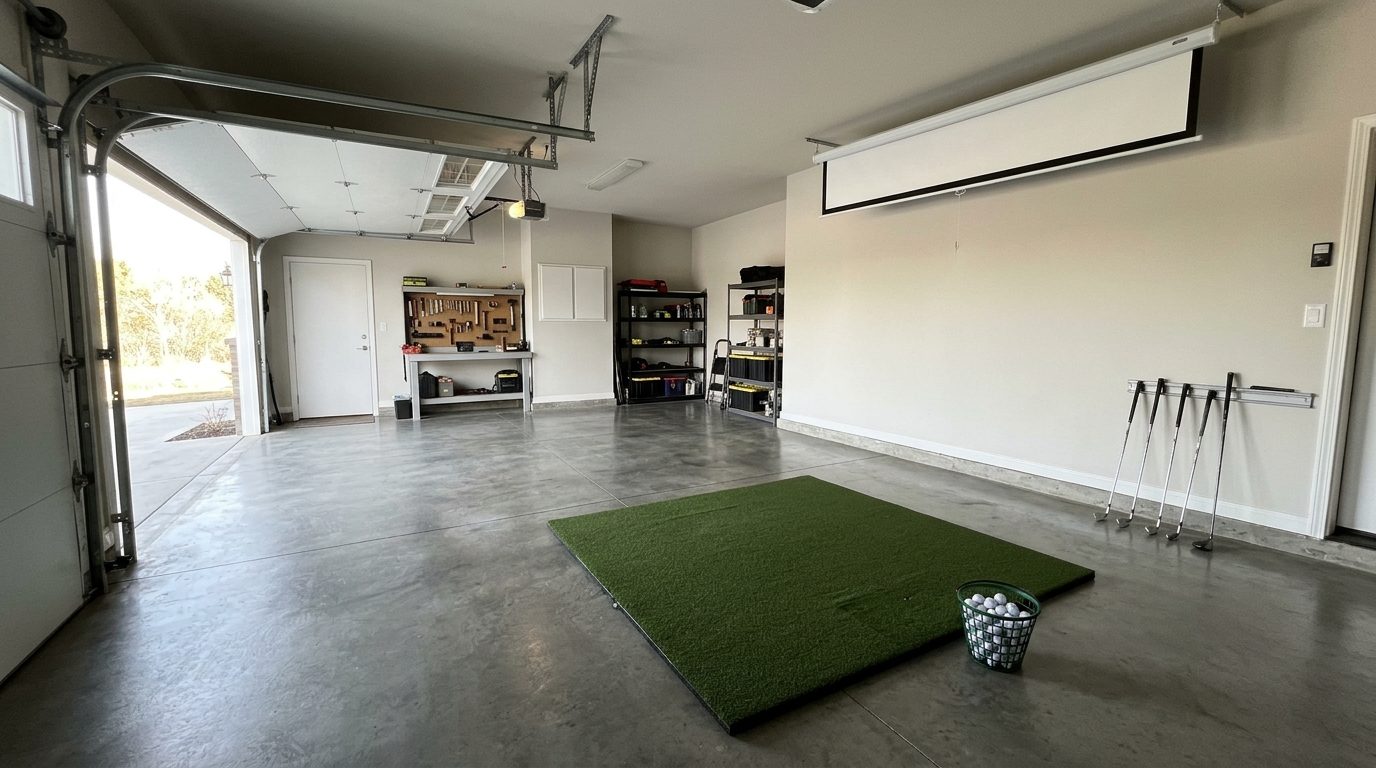
Every brand in this guide markets some form of impact absorption: foam inserts, gel, fiber or a vibration layer. None of the pages we read cite independent lab tests, so treat joint claims as brand claims.
If you already have elbow or wrist pain, ask your doctor or physical therapist before you hit hundreds of balls a week on any mat. A replaceable strip or a gel section is easier to keep in good shape than a worn, packed-down spot.
Real Tees vs Rubber Tees
Hitting a real tee matters for driver practice, because tee height changes launch. SwingTurf and Spornia take a tee anywhere in the turf, the SIGPRO mats take a real tee, and Fiberbuilt and TrueStrike use tee holders built for regular tees.
Fiber vs Turf vs Gel
Fiber systems (SwingTurf) and Fiberbuilt's Pure Impact Turf are built, according to the brands, to let the club move down and through the surface. Turf over foam (SIGPRO, Spornia) is closer in build to a traditional range mat, with more cushion underneath. Gel (TrueStrike) lets the club move into the surface and, according to the seller, punishes fat shots.
Mat Height and Your Launch Monitor
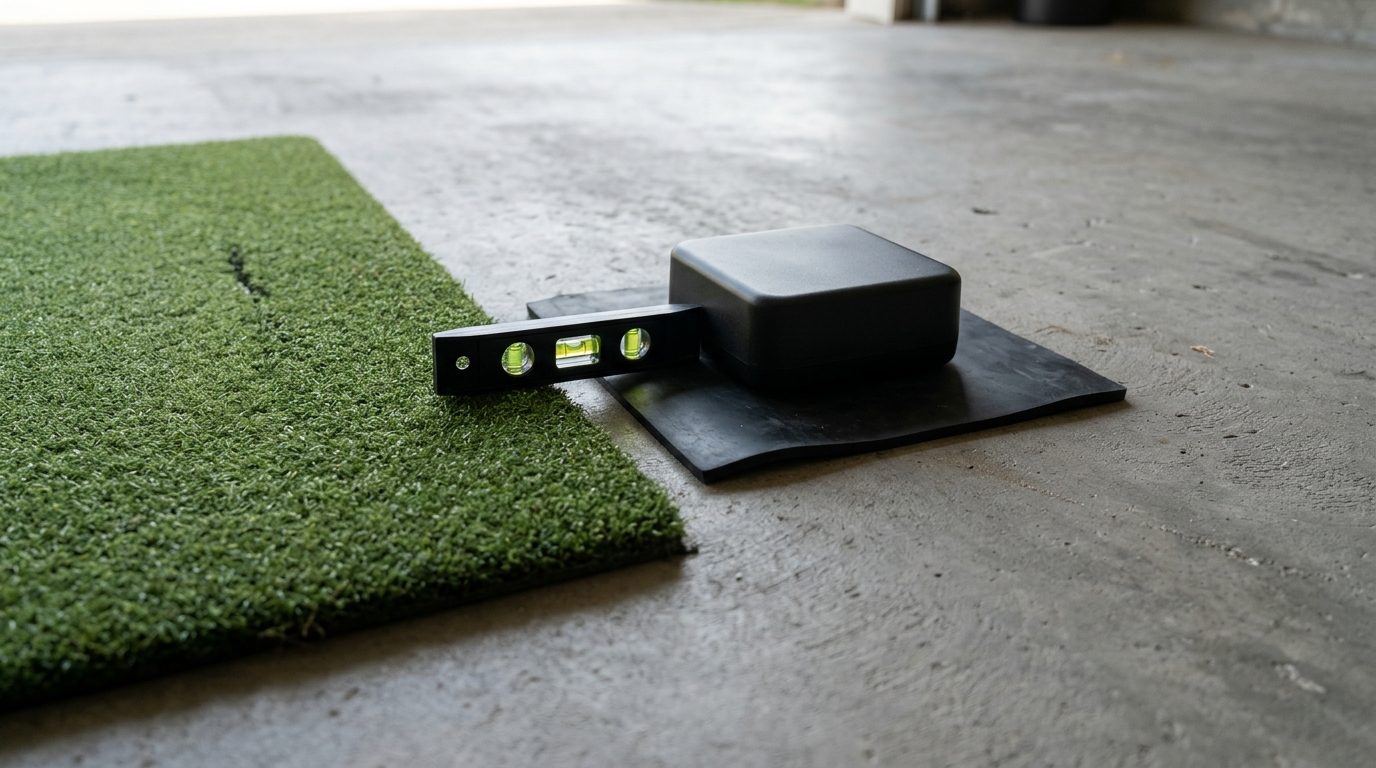
Your mat raises the ball above the floor, and floor-based launch monitors care about that. Garmin's R10 manual says to place the unit 6-8 ft behind the tee and, on a mat, make sure the bottom edge of the launch monitor sits above the mat.
Side-mounted camera units have their own rule. Foresight's GC3 manual says to place the unit about 2 feet from the hitting area and raise it to the same level as the hitting surface when you use a mat. Bushnell's Launch Pro manual gives the same instruction, and overhead units like Uneekor's ceiling-mounted models do not sit on the floor at all.
Mat heights here run from 1.5 inches (Spornia) to 2.5 inches (SIGPRO). That 1 inch difference changes how you shim the launch monitor, so check your monitor's manual before you pick.
Mat Height and Ceiling Clearance
A taller mat also lifts you closer to the ceiling. Shop Indoor Golf's room guide calls for a ceiling of at least 9 feet, and 10 feet for taller golfers. If your room is close, read our guide to ceiling height for a golf simulator before you choose a 2.5 inch mat.
Size
A 4' x 4' or 5' x 5' mat covers the stance for one golfer. A 4' x 7' or longer mat gives room for a side-mounted launch monitor, a ball tray or lefty and righty stances.
Mat width should also line up with your screen and enclosure. Our guide to the best golf impact screen covers sizes and the distance to keep between mat and screen.
Budget
The mats here run from $359.99 on sale to $1,499 at the time of writing. To see where a mat fits in a full build, our golf simulator cost breakdown lays out every line item, and our guide to the best golf simulator for home shows complete setups by budget.
FAQ
Can you use a real tee on a golf simulator mat?
Yes, on many mats: SwingTurf holds a wooden tee anywhere on the surface, Spornia's ProStrike takes a tee in the turf, and SIGPRO Softy mats take a real tee. Fiberbuilt and TrueStrike use holders designed for regular tees, so check each product page before you buy.
How thick should a golf simulator mat be?
Most sim mats in this guide are 1.5 to 2.5 inches tall. Thicker mats usually add foam or gel for cushion, but they raise the ball and you. Check your ceiling height and your launch monitor's leveling rules before buying a taller mat.
Do golf mats affect launch monitor accuracy?
Mat height affects setup. Garmin says the R10's bottom edge should sit above the mat, and Foresight says the GC3 should be raised to the same level as the hitting surface. If the unit sits too low or off level, it may read shots poorly, so follow your manual.
Are golf hitting mats bad for your joints?
Brands like SIGPRO, SwingTurf and Fiberbuilt market foam, fiber and vibration layers as easier on your joints. Those are brand claims, not medical advice. If you have elbow or wrist pain, talk to a doctor or physical therapist before heavy practice.
What size golf mat do I need for a simulator?
For one golfer, a 4' x 4' or 5' x 5' mat covers the stance. If your launch monitor sits beside the ball, or lefties and righties share the bay, a 4' x 7' to 4' x 10' mat gives more room. Measure your bay width first.
Can you put a golf mat on concrete?
Yes, a garage slab is a common base. Fiberbuilt names concrete as a firm, level surface for its mats and says they should not go on bare ground or grass. A flat floor also helps you level a floor-based launch monitor next to the mat.