SimBayLab is reader-supported. When you buy through links on this page, we may earn a commission at no extra cost to you. We don't test products hands-on: our picks are based on manufacturer specs, published tests and owner reports. How we research.
This guide covers height only: what makers publish, how to test your own clearance safely, and what changes it (driver vs irons, mat height, your height). Width and depth are in our room dimensions guide.
Quick Answer
- 9 ft: Shop Indoor Golf says "at least 9 feet", and Rain or Shine says 9 ft "works for most players".
- 10 ft: Rain or Shine says 10 ft or more "gives full swing clearance"; Trackman calls 10 ft the "practical minimum to swing comfortably".
- 8 ft: Shop Indoor Golf warns it "can pose a challenge" and may mean a shorter backswing or no driver.
- Overhead units: Uneekor requires at least 9 ft and mounts its cameras 9 to 10 ft above the hitting area.
- Test it: slow-motion swings with your driver, standing on your mat, before you buy.
Published Ceiling Height for Golf Simulator Setups
Here is what manufacturers and retailers state, word for word where possible. Notice how few launch monitor makers give a number at all.
Source: Shop Indoor Golf · Kind: Retailer guide (Sept 2026) · Ceiling figure: 9 ft min, 10 ft for taller golfers · Context: Trackman 4 room: 11 ft
Source: Rain or Shine Golf · Kind: Retailer, SwingBay FAQ · Ceiling figure: 9 ft for most, 10 ft+ full clearance · Context: Any setup
Source: Trackman (room blog) · Kind: Manufacturer · Ceiling figure: 10 ft+ · Context: TrackMan iO and TrackMan 4
Source: Trackman (garage blog) · Kind: Manufacturer · Ceiling figure: 9-10 ft min · Context: Garage setups
Source: Uneekor · Kind: Manufacturer · Ceiling figure: 10 ft recommended, 9 ft min overhead · Context: EYE XO2, EYE XR list 10 ft min room
Source: Foresight Sports (EU site) · Kind: Manufacturer · Ceiling figure: 3 m (9'10") · Context: Projected simulator
Source: Full Swing (EMEA site) · Kind: Manufacturer · Ceiling figure: 9 ft min · Context: KIT Studio packages
Source: SkyTrak · Kind: Manufacturer · Ceiling figure: Not a number · Context: Depends on your height and club
Source: Garmin · Kind: Manufacturer · Ceiling figure: "Adequate ceiling height" · Context: R10 and R50 manuals
Source: SIG V2 / Net Return bays · Kind: Enclosure makers · Ceiling figure: 9 ft (SIG12 V2: 10 ft) · Context: Minimum room
Sources: Shop Indoor Golf's space guide, the Rain or Shine SwingBay page, Trackman's room size and garage blog posts, Uneekor's setup article, the SkyTrak ST MAX user guide and the Garmin Approach R50 manual. All were read in November 2026.
None of these sources publishes a formula that turns your height into a ceiling number. If you see one online, ask where it comes from.
How to Test Your Swing Clearance Safely
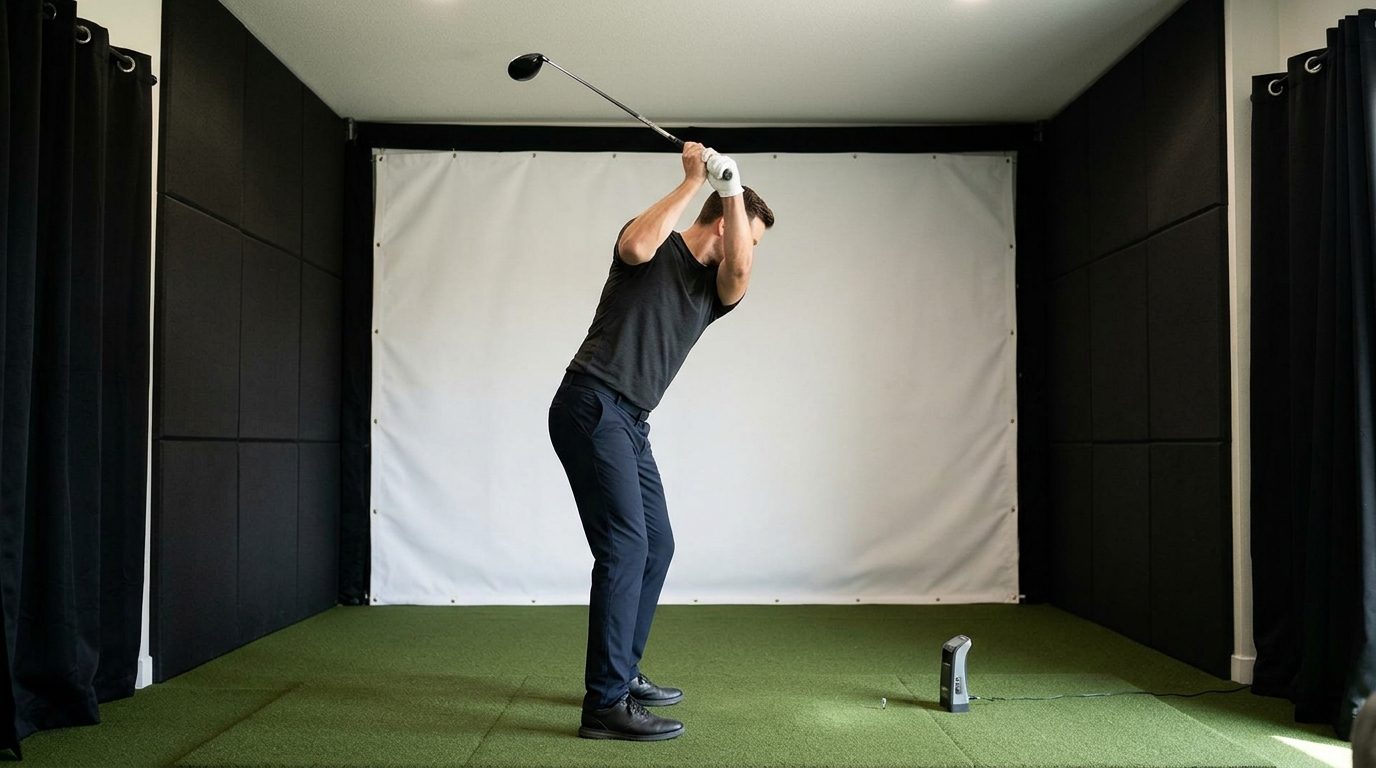
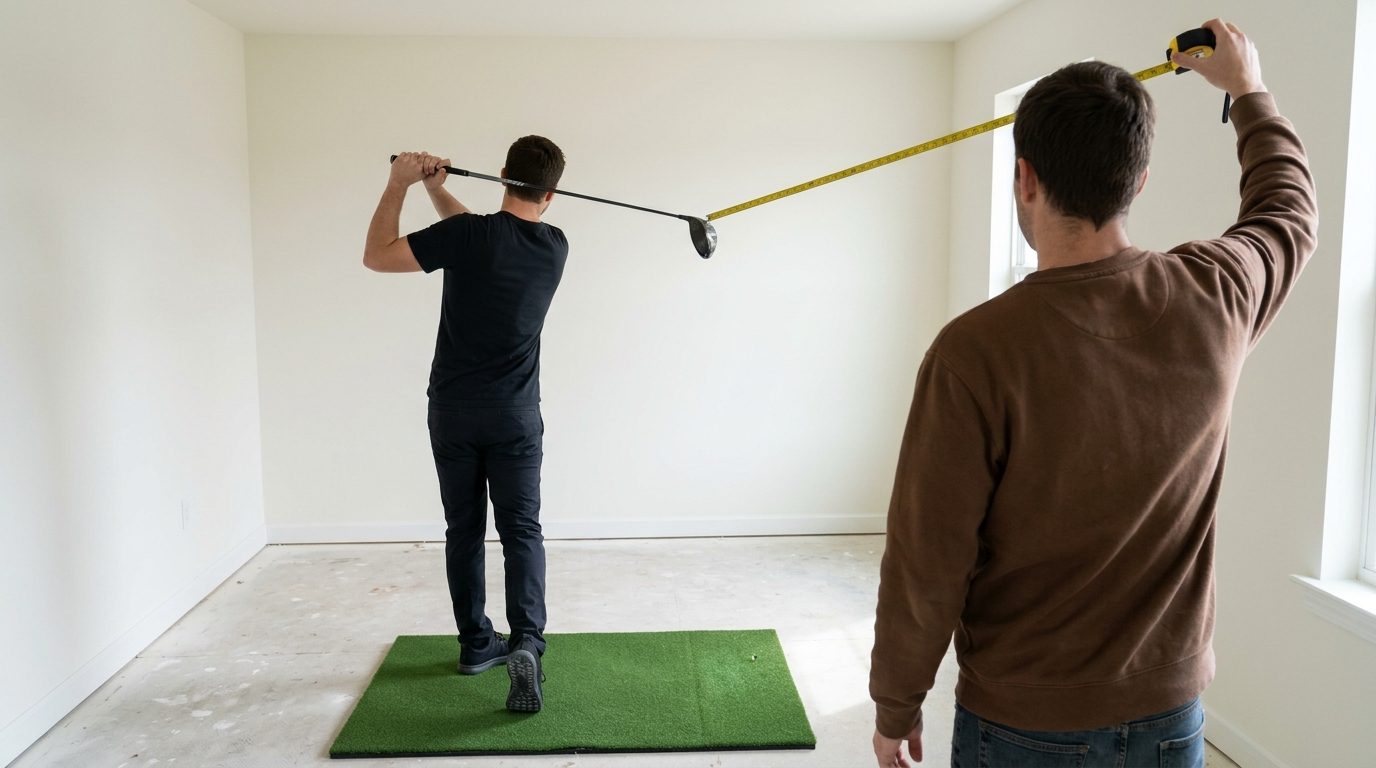
Shop Indoor Golf's advice is the right starting point: test "with your longest club (typically a driver), executing a full backswing", ideally "on a hitting mat, which slightly elevates you." The goal is to find your highest point without ever hitting the ceiling at speed.
- Clear the space. Remove or note light fixtures, fans, sprinkler heads, ducts and, in a garage, the door opener rail. Use no ball, and move people and pets out of the swing area.
- Stand at your real height. Put down the mat you plan to buy, or a board of the same thickness, at the tee spot. Wear the shoes you will play in.
- Swing in slow motion. Take your driver to the top of your backswing at a quarter speed, then through to a full finish. A helper can watch from the side, well outside the club's reach.
- Find the high points. The club often peaks at the top of the backswing and again in the follow-through. Hold still at each one, and only then let your helper step in to measure floor to clubhead with a tape.
- Subtract from your ceiling. The gap left over is your margin. A full-speed swing never exactly matches a slow one, so an inch or two is not a safe margin.
- Repeat with each club. Do the same for a fairway wood, a mid-iron and a wedge, so you know which clubs are safe.
Trackman's advice is the same: swing "slowly at first, then at speed." Only build up speed once slow swings clear with room to spare. If a slow swing comes close, treat that club as off-limits in that room rather than "just being careful".
Garmin's manuals add a second check people forget: make sure your net or impact screen "is high enough and extended enough to account for high-lofted shots or any errant shots." A thin or skied wedge can hit the ceiling in front of you even if your swing clears.
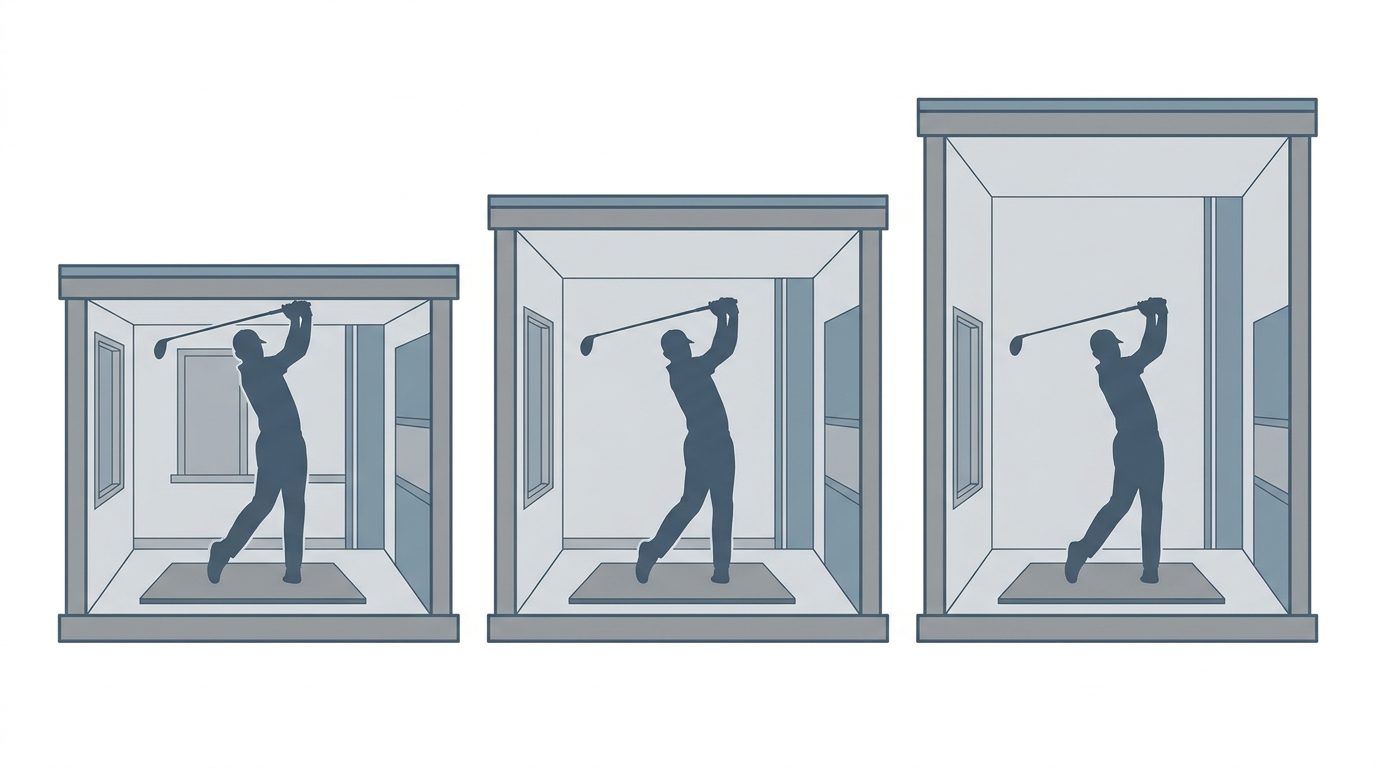
8 ft vs 9 ft vs 10 ft Ceilings
8 ft Ceilings
Shop Indoor Golf says an 8 ft ceiling "often requires golfers to curtail their backswing or refrain from using longer clubs like woods and drivers." It adds that the fear of hitting the ceiling can hurt your shots, too.
That does not rule an 8 ft room out for everyone. Shorter golfers and players working on wedges and irons may still clear, which is why the swing test matters more than the number.
9 ft Ceilings
This is the common published minimum. Shop Indoor Golf says 9 ft "lets most golfers swing a driver fully", Rain or Shine says it "works for most players", and Trackman's garage post says "at least 9 ft of ceiling height, or enough space to swing your driver freely."
Watch the enclosure height. A SIG12 frame is 9'4" tall, and Shop Indoor Golf says a SIG12 with an overhead Uneekor and a BenQ projector needs 9'4" of ceiling.
10 ft and Higher
Ten feet is where Rain or Shine says you get "full swing clearance", and Trackman calls it the practical comfortable minimum. Uneekor recommends 10 ft for its rooms, and Shop Indoor Golf says a Trackman 4 room needs 11 ft.
Driver vs Irons
The driver is usually the club that sets your limit, because it is the longest. Shop Indoor Golf's 8 ft warning names "woods and drivers" for the same reason.
Irons and wedges have shorter shafts, so many golfers who cannot swing a driver in a low room can still hit them. Your swing shape matters as much as the club: Shop Indoor Golf notes that 10 ft suits "upright swings", and a flatter swing may clear a lower ceiling.
If only your driver fails the test, you have options. Practice irons at home and keep the driver for the range, or look at a room with more height for a full bag. Our golf simulator room dimensions guide helps you compare spaces on width and depth too.
Player Height and Mat Height
Taller golfers need more room in every direction. Uneekor already asks for more width for golfers 6 ft or taller, and Shop Indoor Golf ties its 10 ft figure to taller golfers, but neither publishes a ceiling number per inch of height.
Your mat raises you, and every inch counts against the ceiling. Published thicknesses include about 1.5 in for the Spornia ProStrike, 1.7 in for the SwingTurf, 1.75 in for the Fiberbuilt Player Preferred Studio and 2.5 in for the SIGPRO Softy. A raised platform or stage adds more.
Mat height also affects the launch monitor. Bushnell says to raise the Launch Pro "to the same level as the hitting surface", and Garmin wants the R50 at about the tee's height. Our golf simulator mat guide compares mats, sizes and thickness.
Overhead Launch Monitors and Projectors
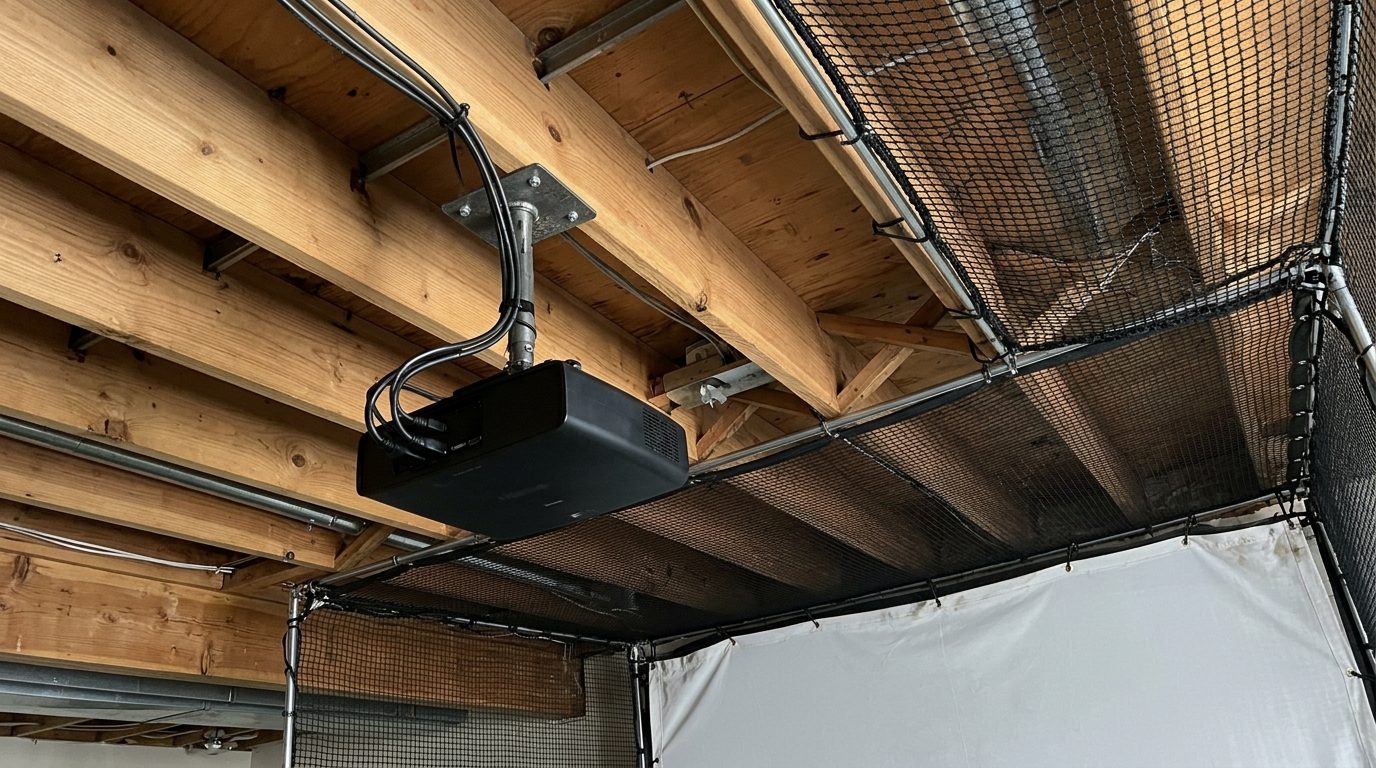
Ceiling-mounted units use your height twice: for your swing and for their own mount. Uneekor says its overhead units need "a minimum height of 9 ft" and are "designed to be mounted between 9 ft - 10 ft off the ground", and it cannot guarantee data accuracy outside that range.
Uneekor measures that height "from the top of the hitting area" to the bottom of the bracket, so a thicker mat or a platform changes it. The TrackMan iO is also ceiling-mounted, and Trackman lists a 10 ft+ ceiling for it.
Mount launch monitors and projectors into ceiling joists, following the mount maker's instructions, never into drywall alone. Power should come from existing outlets with plug-in cords; for a new ceiling outlet or circuit, hire a licensed electrician.
Trackman also says "Side netting and ceiling protection can prevent damage." Rain or Shine, for example, sells a 10 x 6 ft overhead net at $199 list price, on sale for $99 at the time of writing. For complete builds that fit your ceiling, see our best golf simulator for home guide, and for garages, our garage golf simulator guide covers the door rail.
FAQ
What is the minimum ceiling height for a golf simulator?
The most common published minimum is 9 ft. Shop Indoor Golf says "at least 9 feet", Rain or Shine says 9 ft works for most players, and Trackman's garage post says at least 9 ft or enough room to swing your driver freely. Overhead launch monitors from Uneekor need at least 9 ft too.
Can you have a golf simulator with an 8 ft ceiling?
Sometimes: Shop Indoor Golf warns an 8 ft ceiling often means a shorter backswing or skipping woods and drivers, though shorter golfers and iron-only practice may still work. Do a slow-motion swing test with each club, standing on your mat, before buying anything.
Is a 9 ft ceiling high enough for a golf simulator?
For most golfers, according to Shop Indoor Golf and Rain or Shine. Taller players and upright swings may need 10 ft, and some setups need more: Shop Indoor Golf says a SIG12 enclosure with an overhead unit needs 9'4" and a Trackman 4 room needs 11 ft.
How do I test my ceiling clearance for a golf swing?
With no ball and nobody nearby, stand on your mat in golf shoes. Swing your driver in slow motion, then hold still at the top and the finish so a helper can measure the clubhead. Subtract from your ceiling height, keep a real margin, and repeat with other clubs.
Does a hitting mat change ceiling clearance?
Yes. A mat raises you by its thickness, about 1.5 to 2.5 in on the mats listed here, and a platform raises you more. Uneekor also measures its overhead mounting height from the top of the hitting area, so mat height affects the camera setup too.
Models mentioned in this article
Also compare: Photometric (camera) launch monitors · Launch monitors $3,000 to $7,000